Having an affordable place to live is at the heart of the American Dream. Access to affordable housing helps families, communities and economies thrive by supporting financial stability, steady jobs and local economic growth. But finding an affordable place to live is increasingly out of reach for many. Rent and home prices are high, and 22 million households are spending more than 50% of their income on housing costs.
As the nation’s largest multifamily lender and residential bank mortgage lender, JPMorganChase has a track record of helping expand affordable housing supply and supporting homeownership. Along with our financing and policy expertise, we use philanthropy as a key lever to help improve housing affordability. Philanthropic capital helps pilot, de-risk and scale innovative solutions that increase supply, preserve existing affordable homes and expand homeownership opportunities across the U.S.
In 2021, we announced $400 million in philanthropic capital to support innovative housing solutions that increase and preserve affordable housing supply and access to homeownership. The firm’s philanthropic investment surpassed $490 million over the last five years, which supported:
- The creation and preservation of more than 100,000 affordable rental and for-sale homes
- 15,000 first-time homebuyers purchasing a home
- Grantees attracting additional $2.1 billion to advance their work
By working with local organizations and investing in promising approaches that address key cost drivers of building and preserving housing, JPMorganChase is maximizing the impact of philanthropic support to expand affordable rental and ownership options for families across the country.
Supporting innovative construction to build more housing
Although there is no single silver bullet to address the complex challenges of housing supply, JPMorganChase recognizes that innovative construction is an important piece of the solution to lower the costs of new housing production. With construction costs accounting for 64 percent of the average price of a new home, building expenses are a primary financial barrier to increasing housing supply.
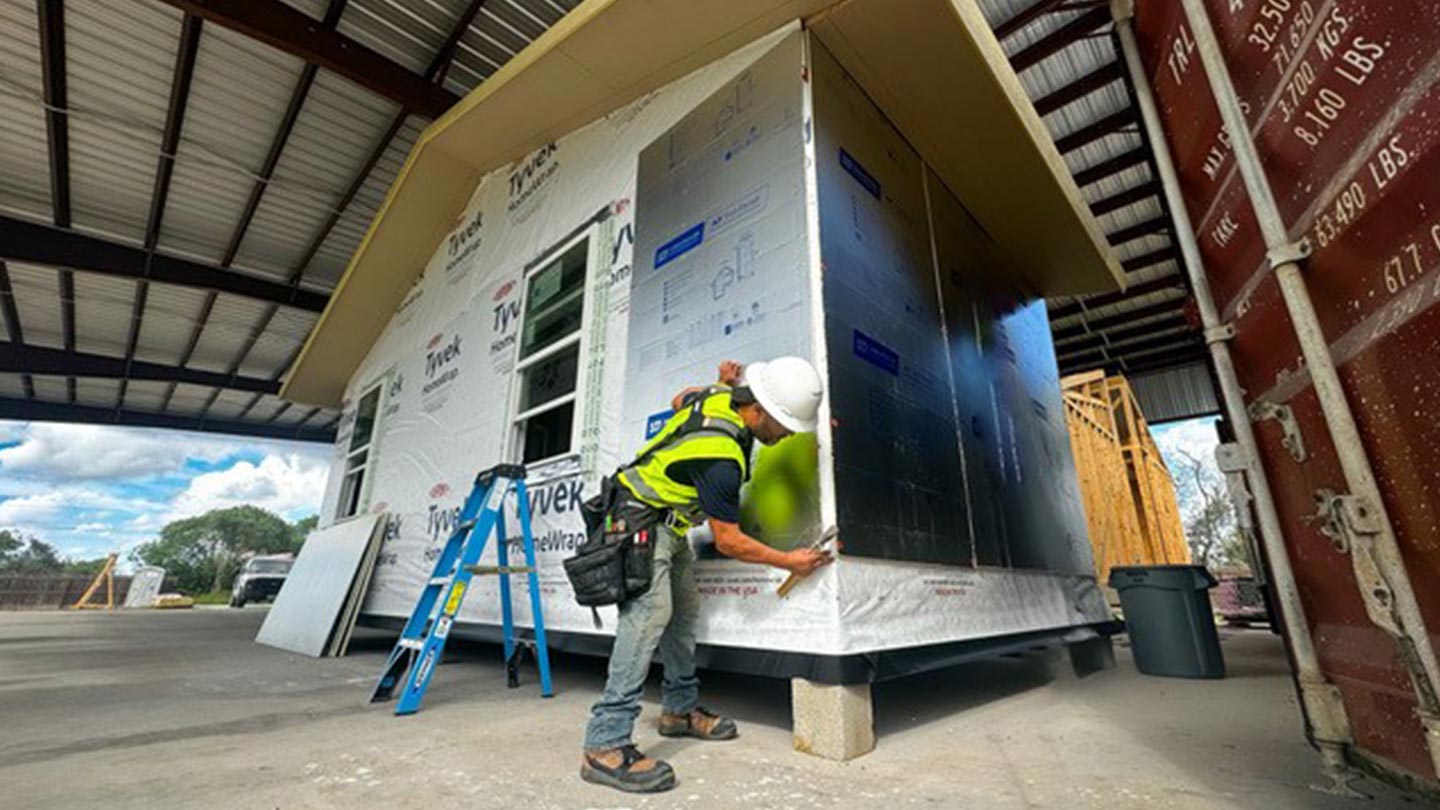
Multiple studies show that contemporary construction approaches can reduce cost and delivery time, with mass-manufacturing and factory production techniques yielding up to 20% cost savings and reducing development time by 20 to 50 percent. Off-site construction—in which building components, panels or entire modules are manufactured in a factory or controlled environment and then transported to the construction site for assembly—is a promising solution, and one that is gaining momentum as housing organizations, manufacturers, lenders and public-sector partners work to modernize how homes are designed, built and delivered. JPMorganChase has invested philanthropic capital in a range of off-site construction models, supporting innovative design, building methods and materials. We have also helped these approaches grow by advancing financing solutions and supporting the ecosystem needed to scale them.
“Innovative homebuilding techniques help to lower costs and shorten timelines, delivering more affordable homes at a lower price. Philanthropy has the power to support early pilots, help fill funding gaps and scale what’s proving effective, and we’re excited to see how innovative construction contributes to a more accessible and resilient housing market” -Laurie Schoeman, Executive Director, Housing Access and Affordability, Global Philanthropy, JPMorganChase
This blog outlines four ways philanthropy can help accelerate innovative construction—turning promising approaches into scalable, financeable solutions that can expand the supply of affordable housing:
- Test innovative construction methods by supporting design work and early-stage pilots that prove new construction methods can work at scale.
- Increase production capacity and scale what works by helping successful approaches increase production, improve efficiency, and reach more communities.
- Expand access to flexible financing to help meet the unique needs of off-site construction projects.
- Strengthen the ecosystem through public-private partnerships and supportive policies that encourage broader adoption.
1. Test innovative housing construction methods
Philanthropic capital is uniquely suited for exploring and testing innovative construction projects. Unlike traditional public or private funding, flexible philanthropic support can cover early costs to experiment with design and conduct pilots to demonstrate feasibility. Grants can support this early testing phase while helping identify what works and where it can be applied most effectively.
Based in Portland, Oregon, Hacienda Community Development Corporation is advancing a first-of-its-kind innovation through its Mass Casitas project, building modular homes with Oregon mass timber. The prefabricated material can be quickly assembled on-site and is described as durable, highly energy-efficient, and fire-resistant—an important design consideration for fire-prone areas and other climates. In rural communities where rebuilding can be slower due to fewer contractors and transportation challenges, this approach paired with off-site construction methods is positioned to help homes be built and deployed more quickly after natural disasters. After an initial pilot of Mass Casitas, JPMorganChase provided a $100,000 grant to help Hacienda study the feasibility of establishing a manufacturing facility capable of mass-producing mass timber modular housing. Once feasibility was confirmed, another $400,000 grant was made to support the pre-development of 40 single-family housing units for low- to moderate-income individuals over the next three years. This replicable model will allow more households to live in affordable homes with lower long-term energy costs.
2. Increase housing production capacity and scale what works
Once a new approach has shown promise, philanthropy can help developers and manufacturers expand production capacity and bring successful models to more communities. This could include fine-tuning products, expanding the manufacturing facility, improving workflow and resource management as well as offering technical assistance to help others replicate proven models.
In the Rio Grande Valley, JPMorganChase’s philanthropic support helped increase the manufacturing capacity of cdcb (come dream. come build.) to bring its DreamBuild modular homes from pilots to early scale. cdcb’s model offers homebuyers a selection of predesigned rooms, or “boxes,” that can be combined into a home, helping streamline design and production. JPMorganChase has provided $4.5 million in philanthropic capital since 2022, first to pilot the DreamBuild model and then to help grow its production capability and upgrade its project and resource management systems to further increase manufacturing efficiency.
DreamBuild is now delivering new, quality homes as affordable as $170,000, with prices varying by features. Since building its first modular homes in 2022, cdcb produced over 40 homes as of 2025, and now plans to build 40 homes in 2026 alone. DreamBuild’s success has attracted significant regional demand and is helping other organizations to replicate this model in Arkansas and Dallas.
3. Expand access to flexible financing for housing supply
Traditional construction lending isn’t designed for the large upfront payments and bulk purchase of building materials that off-site construction requires. Off-site construction also generates different collateral, such as modules, which are not treated as real property until delivered and installed. Philanthropic capital has the power to develop and test creative financing solutions to manage risk and cash flow for off-site construction.
The Housing Accelerator Fund (HAF), based in San Francisco, is a community development financial institution (CDFI) that provides financing solutions that accelerate the delivery of new affordable housing and help preserve existing affordable housing in the Bay Area. Affordable housing developers often face a difficult mix of high upfront costs and long timelines. Before a project can break ground, they may need capital for site acquisition, predevelopment work and permitting—expenses that can come due well before traditional financing is available. To address this need, HAF pools together philanthropic, private, corporate and public sector dollars to provide nimble financing solutions for affordable housing developers.
HAF is a Community Development Banking client and has received philanthropic support from JPMorganChase. JPMorganChase’s Impact Finance flexible loan to HAF supported the launch of a $10 million revolving Industrialized Construction Catalyst Fund, which provides short-term loans to cover critical early construction costs. With the fund, developers can proceed with projects while permanent financing is finalized, reducing costs and delivery timelines for affordable housing.
4. Strengthen the housing construction ecosystem
To propel off-site construction from “innovations” to “mainstream solutions” for housing supply, it’s critical to have a well-coordinated market ecosystem and pursue a regional approach that better aggregates demand, aligns actors across the supply chain, and uses public policies and programs to unlock incentives and remove barriers.
Commissioned by the Washington State Legislature and developed by Civic Commons at the Seattle Foundation and the Washington State Housing Finance Commission, the Comprehensive and Scalable Starter Home Production Plan (SHP) aims to expand the statewide supply of affordable starter homes by pairing conventional construction with innovative offsite and prefabricated methods. Through philanthropic support to Civic Commons, JPMorganChase is helping to catalyze a public-private partnership model by launching a time-limited cross-sector task force and work groups, aligning local governments, housing finance stakeholders, developers and industry partners around shared governance, staffing and operational infrastructure. This partnership is a whole-problem solution, supporting local governments, housing organizations, developers and industry leaders in coordinating their efforts so work on permitting, financing, workforce needs and policy can move forward at the same time.
Innovative construction is a key piece of the solution to increasing affordable starter homes, and Civic Commons is supporting the creation of a Housing Innovation Hub which will facilitate an Offsite Industry Association to organize and strengthen the market for offsite methods including mass timber production. At the same time, a multi-site demonstration will competitively select at least two geographically distinct pilot sites, collectively delivering 30 to 40 for-sale starter homes affordable to households earning 80 to 120 percent of area median income. The project aims to save time and cost by testing new ways to build housing at the neighborhood-scale, using offsite construction with standardized designs, participating in state-level master permitting and sharing project data. These efforts will help prove the approach from concept through completion.
Advocating for policies that support innovative construction
In addition to philanthropy investments, JPMorganChase is also leveraging its policy expertise to highlight policy solutions to support innovative construction. The recent policy brief Unlocking housing affordability through innovative construction focuses on three recommendations: create a regulatory environment that enables innovation in homebuilding; increase public incentives that reduce financing frictions and support demand aggregation; and build the capacity and evidence base needed for market adoption.
Moving forward
Innovative construction is one way to address housing affordability challenges, and this blog demonstrates how philanthropic capital can help move promising ideas from pilot to scale. Philanthropy can support innovative construction by funding early-stage pilots that prove new approaches can work, helping successful models increase production and reach more communities, expanding access to financing tailored to off-site construction and strengthening the partnerships and policies needed for broader adoption. While philanthropy is only one tool, it can play a unique role in reducing early risk, generating evidence and helping effective solutions grow. JPMorganChase will continue applying lessons from our philanthropic investments and community partnerships to help increase and preserve the supply of affordable housing nationwide.
Read more about stories from our grantees: NPHS, cdcb, ROC USA, Hacienda, Abode
Hacienda Community Development Corporation, cdcb (come dream. come build.), Civic Commons and Housing Accelerator Fund are not affiliated with JPMorgan Chase & Co. and its affiliates. JPMorgan Chase & Co. and its affiliates are not responsible for any products and services offered by Hacienda Community Development Corporation, cdcb (come dream. come build.), Civic Commons or Housing Accelerator Fund and do not make any representations or warranties of any kind, express or implied, about the completeness, accuracy, reliability, suitability or availability for any particular purpose. JPMorganChase is not responsible for the information contained on third-party websites, nor do we guarantee their accuracy and completeness. The metrics in this paper are derived from a variety of public and private sources, including data that were self-reported by JPMorganChase grant recipients. JPMorganChase has not independently verified these data and makes no representation or warranty as to the quality, completeness, accuracy or fitness for a particular purpose. The metrics as reported are not directly tied to funds or other support provided by JPMorganChase but rather are a result of a variety of factors.