Two months after Scott and Barbara Benedict moved into the house in Otis, Oregon that they had spent seven years fixing up, it was gone.
“It looked like a bomb went off,” Barbara, 71, said. “Everything was flattened.”
The place they intended to be their retirement home on the coast had burned to the ground in 2020’s Echo Mountain Fire. The Benedicts lost everything.
The couple decided to use insurance money to purchase a travel trailer where they could rest their heads and start to rebuild their lives. “We lived on our scorched lot and spent three years getting it cleaned up to where we could put a house back on it,” Scott, 63, said.
During that time, they also entered a lottery to receive one of six new modular homes developed by Portland-based Hacienda Community Development Corporation, which provides affordable housing solutions to communities. The pilot effort, called Mass Casitas, delivers affordable and sustainable homes made with Oregon mass timber. Instead of the standard lumber used in traditional home framing and building, mass timber construction involves gluing, nailing or screwing together thick, compressed layers of responsibly-harvested wood. It’s a first-of-its-kind innovation in the country that enables housing to be built and deployed quickly in the aftermath of natural disasters. This is especially helpful in rural communities that often have fewer contractors, more transportation challenges and longer rebuilding timelines.
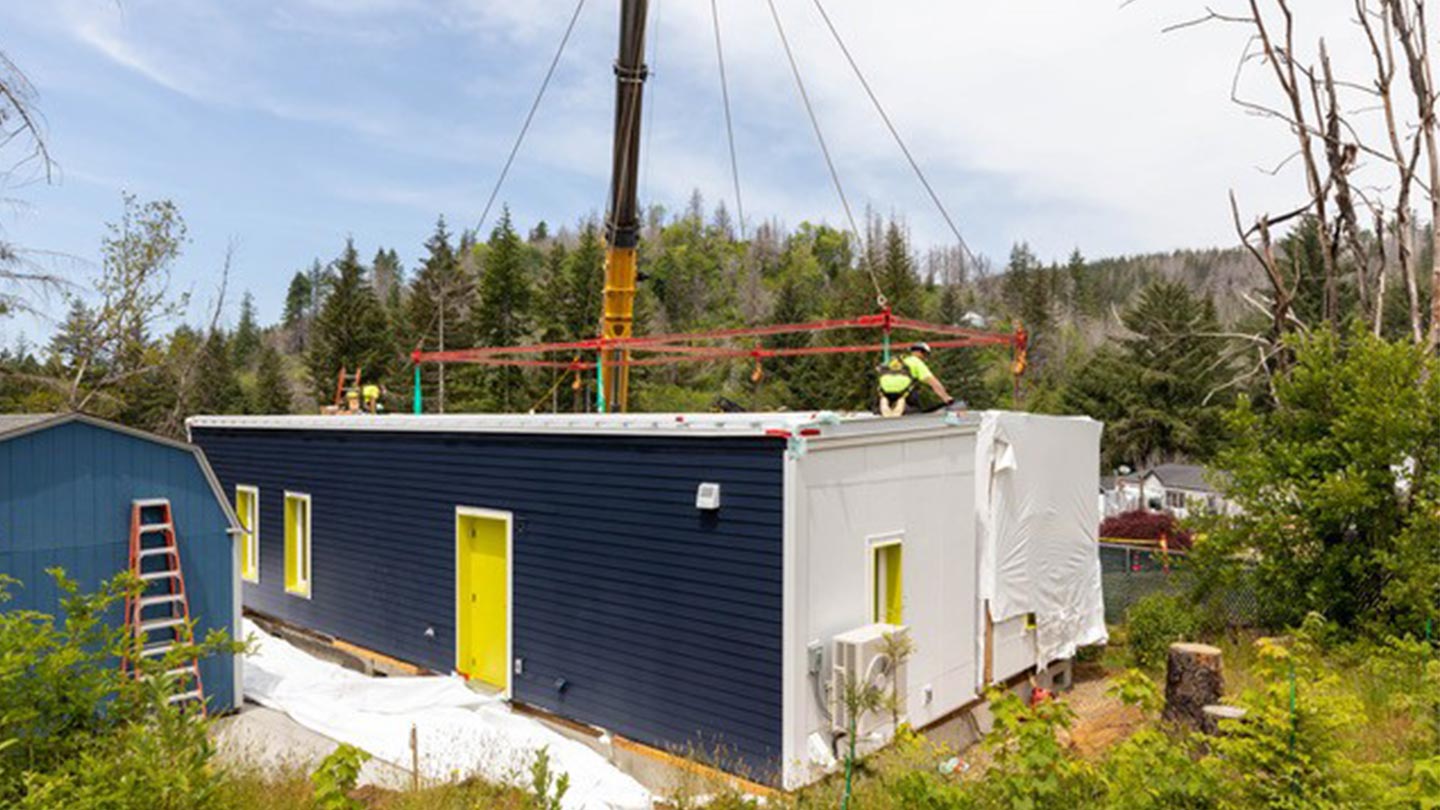
The Benedicts were among the families that Hacienda drew in the lottery. In the summer of 2023, the organization placed Scott and Barbara’s new 1,300-square-foot, 2-bedroom, 2-bathroom modular home on the land that was once blackened with ashes. Inside, it feels cozy, with the timber’s visible texture and knots. “It’s really warm in the winter and cool in the summer,” Scott said.
With philanthropic support from JPMorganChase, Hacienda’s Mass Casitas project is leading a pioneering approach to addressing the lack of affordable housing in Oregon and across the nation. The use of mass timber is a key factor: the prefabricated renewable resource requires less manufacturing energy than traditional building materials, and it can be quickly assembled on site. It’s also durable, highly energy efficient and fire-resistant — it burns in a slow, predictable way rather than igniting rapidly like light wood framing — making it an effective option for fire-prone areas and other climates, too, including wetter regions like where the Benedicts live.
For the pilot, Hacienda developed studios and 2- and 3-bedroom modular homes. The organization assembled the 10 modules for the six houses in a record three weeks. All six homes were completed within four months. That kind of development timeframe means homes can be delivered rapidly to families who need them most, like the Benedicts.
Unlike traditional construction that is done piece-by-piece on site, modular construction involves fabricating sections of a home in a factory. Hacienda manufactured “volumetric” modules for Mass Casitas, which are fully enclosed rooms that were transported and installed at their final sites throughout Oregon. Since modular housing is mass produced in a controlled environment, the labor, material and construction times and costs are significantly lower than conventional homebuilding.
“Addressing housing affordability requires a range of solutions that can increase housing supply and meet the needs of different communities,” said Vicki Foege, Vice President, Global Philanthropy, JPMorganChase. “Hacienda’s Mass Casitas project is exploring how mass timber and modular construction can create high-quality, energy-efficient homes while helping develop new models for housing production that can be replicated across Oregon and beyond.”
With additional philanthropic support from JPMorganChase, Hacienda is now scaling Mass Casitas, focusing on predevelopment of 40 single-family housing units that will be delivered to individuals and families with low and moderate incomes over the next three years. As part of this phase, Cervantes said Hacienda is further exploring design options, manufacturing sites, geographic locations for the homes and additional ways to reduce costs.
“We have a good understanding of the vertical construction costs, but once the homes are integrated on site, the land is where the price goes up,” she said. “That’s why we’re also exploring things like community land trusts” to bring more affordable housing within reach for people who need it most.
“We love the place,” Scott said of their modular home.
“It’s a place where we can be ourselves, relax and be safe,” Barbara added. “I appreciate that now since we lost everything — just to have a nice, comfortable home.”
Hacienda Community Development Corporation is not affiliated with JPMorganChase & Co and its affiliates. JPMorganChase & Co and its affiliates are not responsible for any products and services offered by Hacienda Community Development Corporation and does not make any representations or warranties of any kind express or implied about the completeness, accuracy, reliability, suitability, or availability for any particular purpose. JPMorganChase is not responsible for the information contained on third-party websites, nor do we guarantee their accuracy and completeness.