California’s success has always been powered by its people—from educators and healthcare workers to innovators and entrepreneurs—who strengthen neighborhoods and drive the economy. JPMorganChase has served the Golden State for more than 135 years and is helping residents tackle a shared challenge: finding an affordable place to live.
California’s housing affordability challenge isn’t confined to any one city. Across the state—from coastal cities to inland communities—high costs and limited housing supply are pushing families farther from jobs and schools and making it harder for employers to retain the workforce that communities rely on.
That’s why JPMorganChase launched the American Dream Initiative, a multi-year effort to help expand economic opportunity for more people across the nation. This includes finding an affordable place to live—as part of this effort, we intend to deploy more than $750 billion through 2035 to help increase housing supply and support homeownership nationwide.
In the San Francisco Bay Area, where challenges with housing supply and high costs are especially acute, our approach often comes to life through coordinated, local partnerships.
Financing: bringing scale and local expertise to housing
To build more housing, communities need funding that fits the real-world complexity of development. Through our American Dream Initiative, we’re expanding housing financing using tools like debt, equity, and grants—working with the real estate community, local governments, and nonprofits to expand housing supply, including a financing goal of 1,000,000 affordable units over the next decade. In the Bay Area, these efforts show up through locally tailored partnerships that help move complex projects from planning to construction to delivery.
Over the past five years, we have deployed more than $5.6 billion in financing for affordable housing construction and preservation across the region, helping to build or preserve nearly 26,000 affordable housing units for Bay Area residents. We’re building on this foundation with a clear goal: help finance and unlock more housing at a range of income levels, including homes within reach for middle-income households.
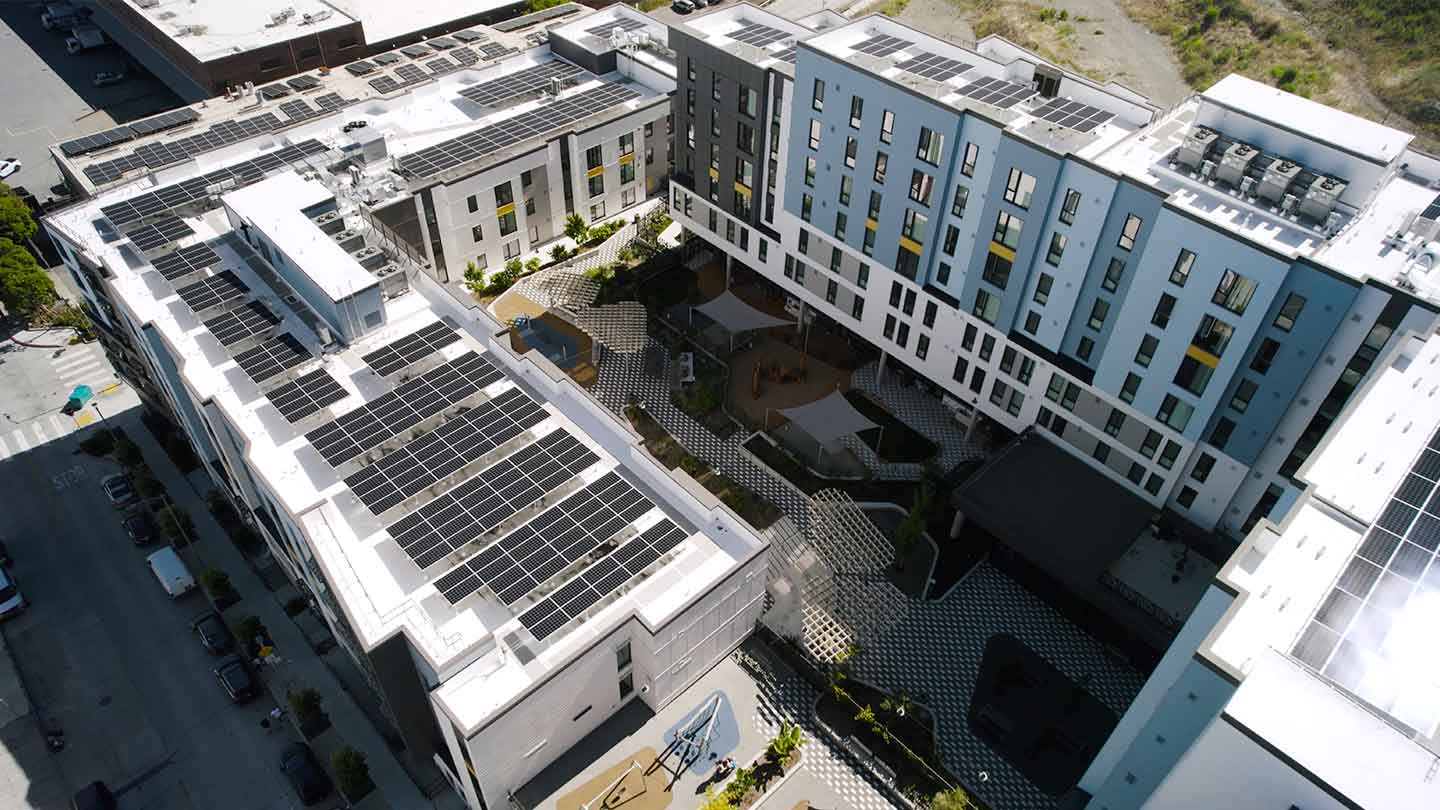
And we’re focused on outcomes. A recent example is the Sophie Maxwell building in the Dogpatch neighborhood’s Power Station development, where JPMorganChase provided financing to help deliver 105 permanently affordable apartments. By coordinating closely with public officials and other funding partners, the project’s innovative capital structures brought much needed housing to market at a lower cost per unit. The building is now fully occupied—delivering the kind of housing that helps keep communities stable and opportunities within reach.
We’re taking those lessons forward: supporting what comes next at Power Station by providing nearly $200 million in financing for an additional 342-unit residential building. We’re also making up to a $15 million equity investment in Fifth Space’s Essential Housing Fund, which is expected to include support of 250 affordable units in Potrero Hill.
Policy: reducing barriers to deliver housing faster
In San Francisco, capital is necessary—but the policy environment often determines whether that capital can be deployed at the scale and speed the market needs. When zoning and permitting are unpredictable, timelines can stretch, carrying costs can rise, and total project costs can climb. That friction doesn’t just slow production; it shrinks the pool of projects that can be financed in the first place.
To help address this in the Bay Area, we’re supporting the Urban Land Institute (ULI) Foundation, working with Terner Labs and other research partners, to analyze key housing data and develop actionable policy recommendations for the region. Our philanthropic grants to SPUR and The Housing Action Coalition also advance this goal by supporting work to improve local housing policy and processes, like examining building code reforms and other changes that can reduce the cost and complexity of housing construction.
Philanthropy: helping pilot, de-risk and scale local solutions
Some of the biggest barriers to building more housing appear well before construction begins. Philanthropy is a complementary tool that can help pilot, de-risk, and scale solutions so that financing can be deployed more effectively.
That’s why JPMorganChase is providing $6 million in new philanthropic support to local organizations working across the Bay Area: the San Francisco Housing Accelerator Fund, Community Vision Capital & Consulting, San Francisco Bay Area Planning and Urban Research Association (SPUR) & The Housing Action Coalition, and Housing California. These grants are designed to strengthen the housing ecosystem—preserving existing affordable homes, accelerating new construction, and reducing barriers to production—so more housing can be built in the communities that need it.
Moving forward together
Housing affordability in the San Francisco Bay Area won’t be solved by any one institution or tool. Progress requires alignment across developers, nonprofit organizations, public agencies, employers, and community groups.
Our approach pairs financing with targeted philanthropic support and policy engagement to help expand supply, preserve affordability, and reduce uncertainty in a high-cost market. A resilient economy starts close to home—when affordable housing is within reach, families can stay rooted, build a stronger financial future, and continue to call the Bay Area home.