CIB Revenue

Creating thriving communities together
See how our clients and partners—from small business owners to workforce training leaders—work with JPMorganChase to drive meaningful impact and economic growth where they live and work.
Learn moreLatest news

Veteran’s Unconventional Path to Landing her Dream Job in Tech
U.S. Army Veteran Ashley Wigfall transitioned to a civilian role and charted her path to technologist through mentorship and skills training at the JPMorgan Chase tech hub in Plano, Texas.
Learn more
2025 ANNUAL REPORT
Troy Rohrbaugh, Douglas B. Petno, Letter to Shareholders
April 6, 2026
The integration of our businesses has created a powerful ‘combustion effect’ — igniting growth and unlocking new opportunities across our expanded organization.
Troy Rohrbaugh | Douglas B. Petno
Co-CEOs, Commercial & Investment Banking
In 2025, the Commercial & Investment Bank (CIB) reached an inflection point — delivering exceptional financial performance while expanding the capabilities we bring to clients worldwide.
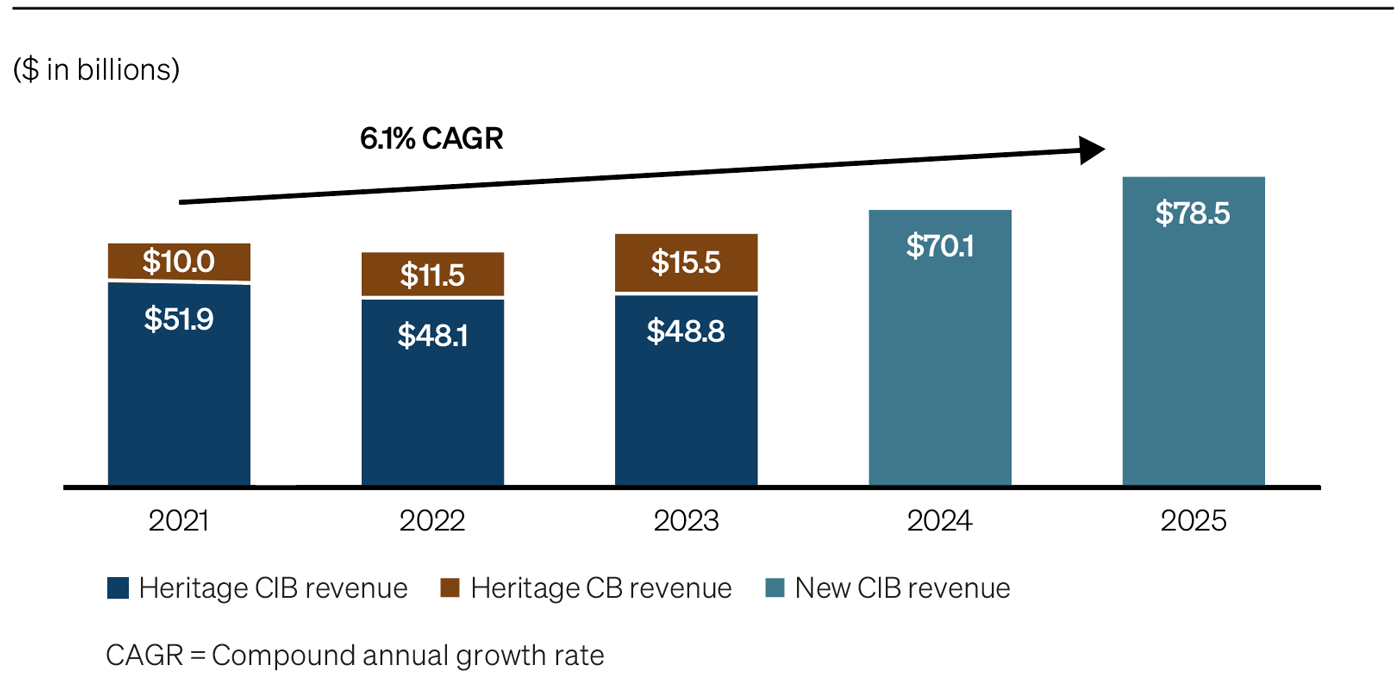
The early 2024 integration of Commercial Banking (CB) with the Corporate & Investment Bank has proved to be a defining strategic move, creating an engine for growth and a scaled platform to serve clients of all sizes. Since the merger, revenue has grown at a compound annual rate of 10%.1
In a year marked by heightened volatility and wavering business confidence, the strength of our combined franchise and fortress balance sheet enabled us to deliver unmatched value to our clients while generating strong operating and financial results.
Despite the headlines, the global economy was sturdier than expected, with growth underpinned by strong corporate earnings, resilient household demand and a sharp upswing in artificial intelligence (AI)-related capital expenditure. At the same time, competition intensified — both from established institutions and from nonconventional players — and regulation continued to evolve.
Amid these dynamics, AI became the battleground of competition and the defining market force. As for our own investments, we moved early and decisively, grounded in years of practical application, and are now scaling our capabilities. Throughout 2025, we stayed focused on executing our strategic priorities: Advancing AI adoption and business optimization across the CIB while accelerating our growth agenda, including international expansion, private capital and digital assets. We remain excited about the opportunities ahead.
Simply put, we like our hand. Our unified platform positions us to best serve our clients and invest with conviction to extend our lead and deepen the moats around our market-leading businesses.
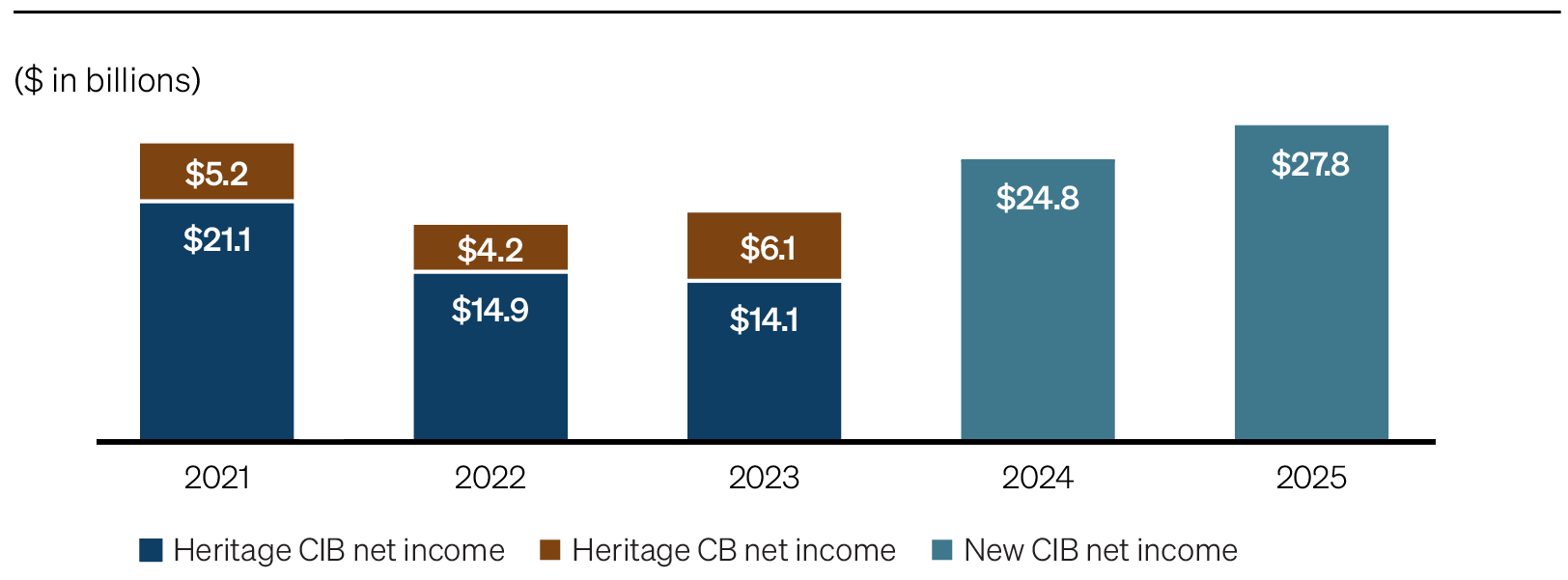
Against this backdrop, our franchise reported net income of $27.8 billion on record revenue of $78.5 billion, up 12% from the previous year, and achieved a full-year return on equity of 18%. Here are highlights across our businesses:
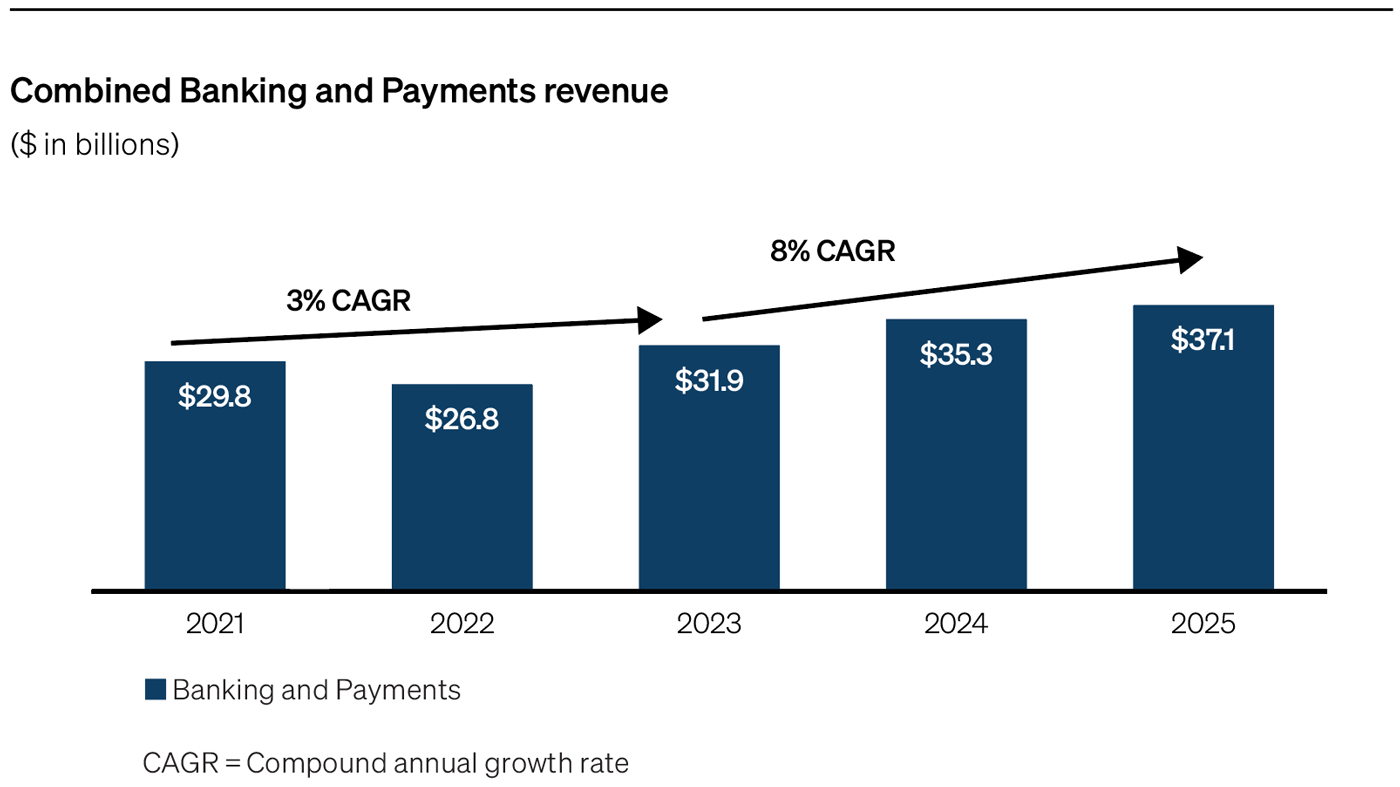
Our Global Banking team delivered strong performance, reporting $37.1 billion in revenue, a 5% increase year over year. These results were driven by our sharpened client segmentation strategy, which provides targeted sector expertise and seamlessly delivers our full suite of capabilities. No matter where our clients are in their life cycle, our people, products and platforms are positioned to support them — reinforcing our value as a trusted, long-term partner.
Commercial Banking achieved a standout year, highlighted by record deposits, which rose 13%, and a 44% surge in Investment Banking fees, surpassing $1 billion for the second time. Our footprint now extends to 92 of the top 100 U.S. metropolitan areas, with further expansion on the horizon. Overall, CB revenue rose 3% to $11.9 billion, fueled by record payments activity, an increase of over 80% in Commercial Real Estate lending originations and nearly 3,000 new relationships in Commercial and Specialized Industries. Today, CB serves nearly 60,000 clients across more than 160 locations.
Global Corporate Banking (GCB), operating in over 40 countries, continued to provide comprehensive support to leading multinationals, financial institutions and public sector organizations. GCB and Global Investment Banking (GIB) reported revenue of $25.3 billion, representing a year-over-year increase of 6%. Notably, we added approximately 400 new relationships during the year, further strengthening our global franchise.
In the face of intense competition, GIB retained its #1 global ranking2 with an 8.4% wallet share2 and finished with top positions across Equity Capital Markets and Debt Capital Markets, as well as in Europe, the Middle East and Africa (EMEA), Latin America and North America.2 While higher rates and policy uncertainty initially dampened M&A and capital markets activity, momentum accelerated in the second half of the year as corporate clarity returned and businesses adapted to new risks. Total announced volume in global M&A reached $5.1 trillion, up 43% from 2024,2 marking the second-best year on record, supported by a resurgence in large M&A and financial sponsor activity. We advised on several landmark transactions, including the $111 billion Warner Bros. Discovery sale and the $56 billion Electronic Arts buyout, with J.P. Morgan also leading the acquisition financing. Debt capital markets saw strong momentum, with a record $5.1 trillion2 in repricing and refinancing activity as investor demand rotated toward issuers with faster growth and more conservative balance sheets and broadened across sectors. In equity capital markets, global volume rose 21% to over $812 billion.2
Our Payments franchise, in close partnership with Global Banking, has been a powerful growth driver, delivering exceptional results in 2025. The team reported a record $19.3 billion in revenue — a 7% increase over the previous year. Deposits grew by 13% and fees by 10%, reflecting broad-based momentum. As a provider of critical financial infrastructure, this business moves money securely, efficiently and at an unparalleled scale. Routinely handling payment volume equivalent to the world’s gross domestic product roughly every week and a half, our Payments team set a new single-day record by processing an extraordinary $16.1 trillion. These achievements underscore both the resilience of our platforms and the deep trust our clients place in us.
Since 2019, our market share has expanded by 400 basis points, exceeding 10%,3 spurred by new client acquisition, the global transition to digital payments and ongoing industry consolidation. Continued strategic technology investments and an unwavering commitment to innovation have also kept us at the forefront of this rapidly evolving sector, solidifying our position as an industry leader. Last year, we launched JPM Coin on a public blockchain, marking a new era in digital money, while Kinexys, our blockchain-based platform for secure, real-time institutional payments and settlement, now processes over $5 billion daily.
In Markets, our traders navigated a year of significant global volatility and achieved outstanding results. Geopolitical shocks and unexpected policy moves led to sharp swings, including a 15% drop in the S&P 500 following tariff announcements on “Liberation Day.” On the most turbulent day, our Equities platform processed an unprecedented 3.2 billion order and execution messages — almost 25% higher than the previous peak — ensuring investors could continue to access liquidity and execute trades seamlessly.
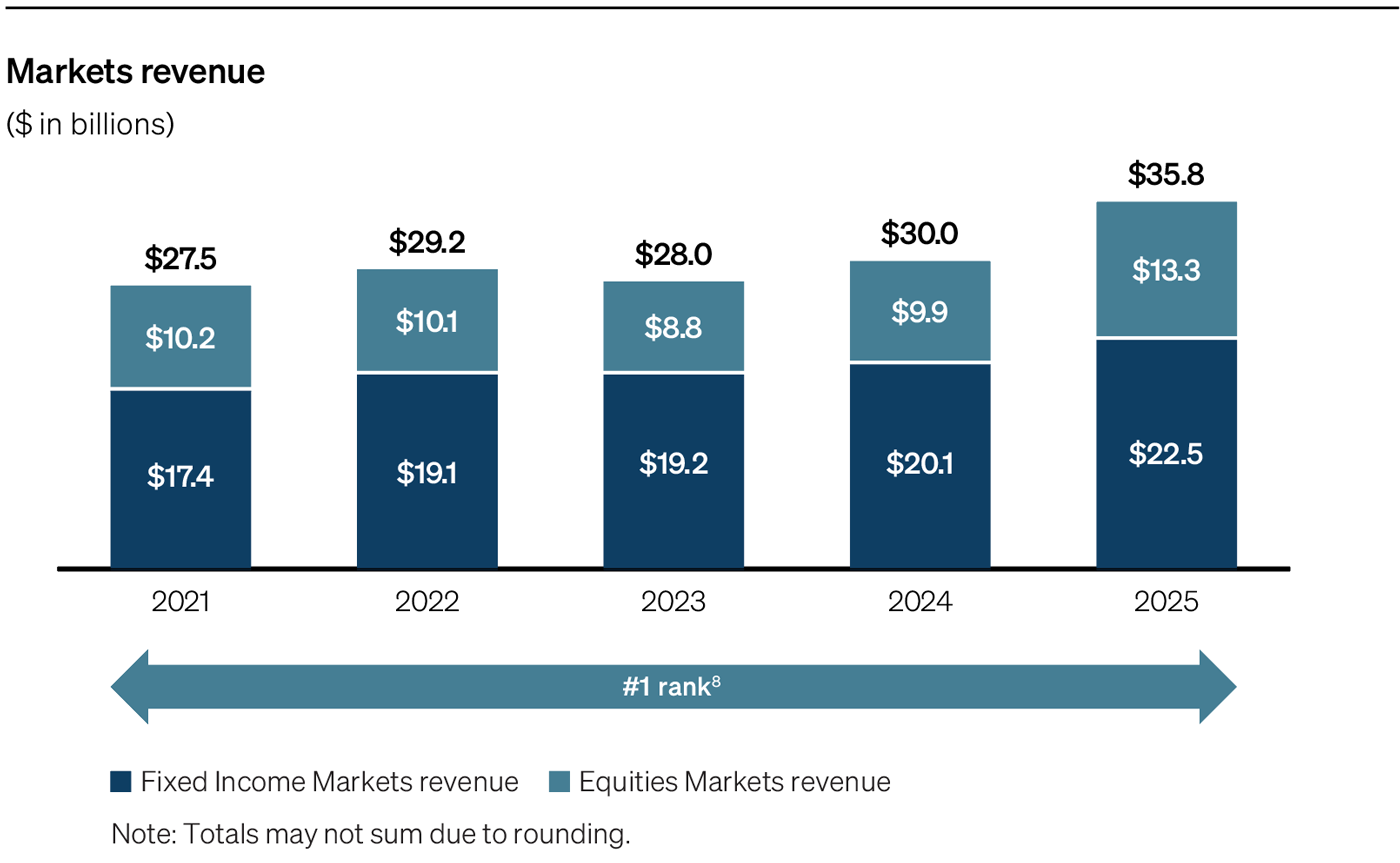
This reputation as a reliable partner in all market environments translated into standout performance. Markets revenue reached a record $35.8 billion, up 19% from 2024. Fixed Income revenue grew 12% to $22.5 billion, driven primarily by strong results in Rates, Currencies & Emerging Markets, Commodities and Securitized Products. Macro products — especially Commodities — benefited from the heightened volatility and safe-haven demand, pushing precious metals to record highs by year-end. Similarly, Equities reported standout growth, setting a new revenue record of $13.3 billion, powered by solid performance across products particularly in Equity Derivatives.
The Markets business continues to hold leadership positions across the trading life cycle. Last year, we achieved the “triple crown” of research awards — Extel’s top Global Research Firm, #1 Global Fixed Income Research Team for the sixth consecutive year and #1 Global Equity Research Team — for the fourth time in the past five years.
Securities Services also set new benchmarks last year. As the only global custodian operating alongside leading markets, payments and banking franchises, we offer front-to-back client capabilities — from research and execution through clearing, settlement and custody — and the ability to manage complex assets at scale.
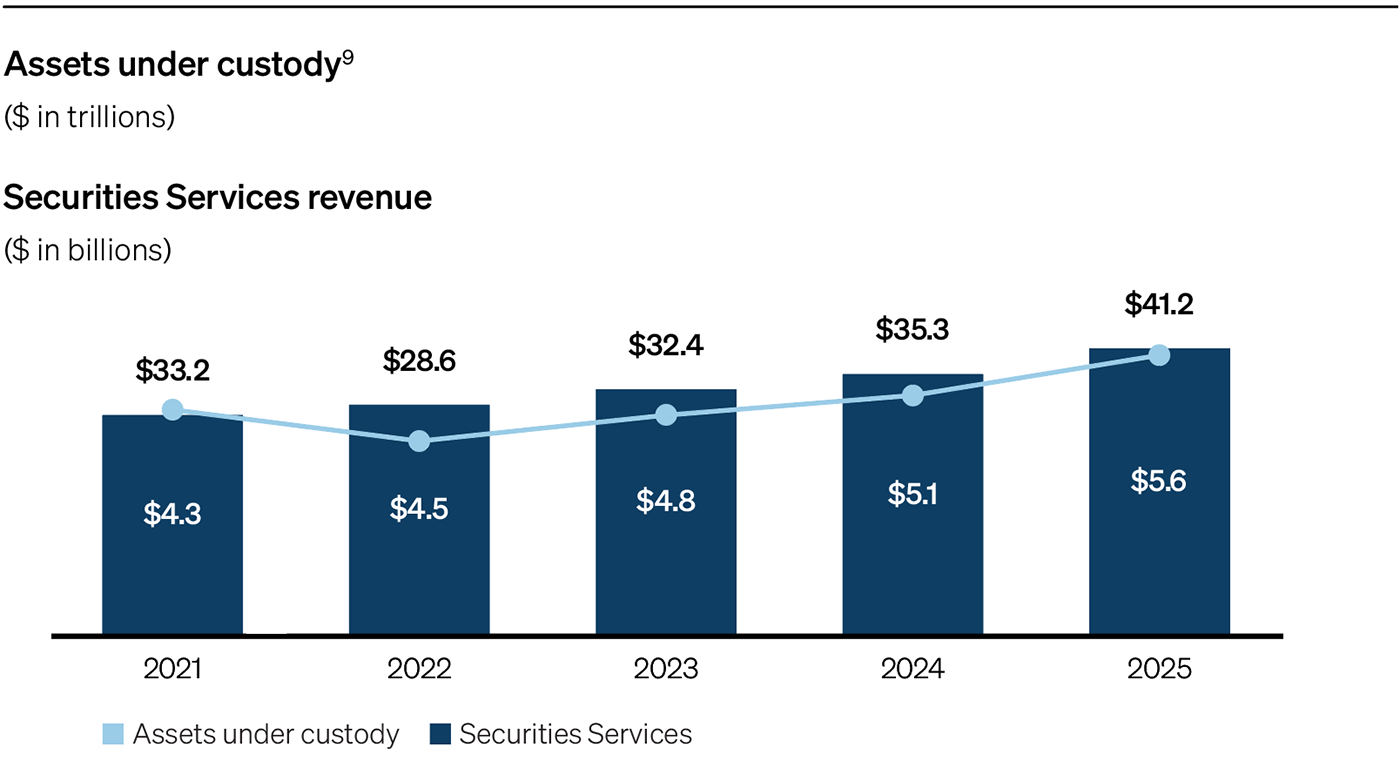
In 2025, the business generated $5.6 billion in revenue, 10% higher than in 2024 and marking our sixth consecutive year of record results. We are currently the #3 player and a leading asset servicing provider,4 underpinned by years of sustained investment in our platforms and multiproduct growth with clients.
This exceptional performance is a result of our proven strategy, as well as the incredible efforts of our teams and their focus on clients’ evolving needs.
What has made us successful so far, however, will not necessarily make us successful in the future. Today, the CIB faces a radically shifting landscape. Competition is intensifying on all fronts. Traditional banking rivals are investing heavily to reclaim share; nonbanks — payments players, market infrastructure providers and fintech platforms — as well as nonconventional entrants, are scaling into areas once considered the preserve of universal banks; and specialist boutiques are broadening their reach, stitching together advisory, execution and distribution. In many of our businesses, there are now multiple challengers lining up at every step in the value chain.
In parallel, the pace of technological innovation has accelerated dramatically. Breakthroughs in private markets, digital assets and blockchain are reshaping capital flows. The AI boom is triggering unprecedented capital needs, turning banks into ecosystem builders, and making chips and rare earth minerals the new strategic assets. Meanwhile, geopolitical tensions have intensified, making energy, infrastructure and defense central to political strategies, reflecting a realignment of the world order.
For the CIB, these forces raise the bar and give us an opportunity to lead. We are not standing still: We are on offense, with major technology priorities in flight and identified ownership for delivery. The integrated CIB gives us clear structural advantages — scale, deep client relationships, balance sheet capacity, global reach, AI capabilities and a vast data set. Our task now is to convert those strengths into simpler, more seamless client experiences and higher return growth.
Here’s how we’re positioning to stay ahead:
The integration of our businesses has created a powerful “combustion effect” — igniting growth and unlocking new opportunities across our expanded organization. Uniting our teams has amplified our collective impact, making the whole greater than the sum of its parts.
For example, in Global Banking, by combining our leading U.S. Commercial and Specialized Industries franchise with the deep sector expertise of our investment bankers, we are supporting clients with high-value opportunities, including sell-side mandates and capital raising. This drives deeper client engagement and expands our share of wallet.
Our industry coverage is also complemented by a targeted focus on high-growth subsectors, such as enterprise and cloud, applied technology, biotech and healthcare services, where our bankers’ expertise delivers differentiated value and positions us to capture outsized growth.
At the same time, our larger business footprint creates more scope to broaden client engagement with macro solutions, especially foreign exchange. While we have long been strong in the U.S. dollar and other major currencies, the integrated platform is accelerating our expansion into new markets, offering clients a more comprehensive suite of solutions and deepening our relationships.
Despite increased scrutiny of private credit in recent months, we believe private markets will remain an important part of the financial system over the long term.
Today, private companies far outnumber public ones, with many choosing to remain private longer due to the high costs and complexities of public listings. Simultaneously, surging investor appetite for private assets is reshaping capital flows and creating new opportunities for growth. Assets under management in private markets have grown at an annual rate of 14% since 20135 and are projected to nearly double — from around $17 trillion in 2024 to $32 trillion in 2030.6
Clients in these markets are increasingly interconnected, forming a network where limited partners, general partners and portfolio companies collaborate and influence each other’s banking, financing and advisory needs.
To best serve this ecosystem, the CIB has launched several initiatives. We have reorganized our coverage model to serve the private capital markets in a more integrated way, creating a joint venture between the CIB and the Private Bank to deliver seamless solutions — from frictionless access to liquidity to creative monetization strategies — at every stage of the private capital life cycle. Meanwhile, our new Private Capital Advisory & Solutions team provides clients with comprehensive advice across the private capital spectrum, connecting investors and companies well before any IPO or sale.
On the financing side, we remain a reliable provider of credit to well-established direct lenders. In addition, last year, we launched the Strategic Financing Solutions group, combining Global Banking and Markets structuring expertise to offer clients a comprehensive suite of financing options — from direct lending to syndicated loans and high yield. Our direct lending platform has expanded as well, with $14 billion total exposure7 from our $50 billion commitment to private credit, alongside over $25 billion of partner capital available.
Finally, in an industry first, we introduced private company sell-side research last year, providing in-depth analysis on influential companies such as OpenAI, Anthropic and Stripe — businesses driving innovation in their sectors.
Today, nearly 40% of the CIB’s revenue originates from outside the United States with broad-based growth across Asia Pacific, EMEA and Latin America. Our scale, deep local expertise and ability to navigate complex regulatory and geopolitical landscapes have enabled us to deliver effective solutions to clients worldwide.
The opportunity ahead is significant: International markets are poised to outpace domestic growth, fueled by economic diversification, rising cross-border trade and a new wave of investment — particularly in the Middle East, North Africa and Turkey. Amid evolving regional dynamics, we are advancing with a measured, phased approach designed to protect continuity of service and client outcomes.
To capture this regional growth, we are investing in our capabilities in Bahrain, Saudi Arabia and the United Arab Emirates, as well as expanding our franchise in Turkey. In addition, we’re increasing critical infrastructure in Africa, including a new onshore presence on the Ivory Coast and Kenya. Our focus extends beyond serving large multinationals to include international mid-cap and institutional clients, as well as subsidiaries of U.S.-based firms.
A key driver of our expansion is extending our Payments solutions in new geographies. Today, the firm processes around 65 million transactions daily and moves nearly $12 trillion across 120 currencies. But the ambition is broader — to expand coverage and products across venture capital, the Innovation Economy and mid-cap corporates while deepening our offerings in equities and fixed income.
Across the CIB, we’re rewiring our business to embed AI in every process, maintain modern data architecture and drive measurable business outcomes.
AI is already creating material efficiency gains. In transaction screening, AI has enabled us to review more than double the volume while halving the number of manual operator checks. That means quicker turnaround for clients and fewer delays. AI is also elevating how we work — cutting manual tasks, accelerating innovation and improving client outcomes. Over 90% of our engineers now use AI code assistants, and more than 65,000 CIB colleagues actively use LLM Suite, our generative AI platform.
We’re deploying AI proactively for clients, too — corporate treasury clients now have a cash-flow-forecasting tool that supports smarter liquidity management. In Markets, Prime Finance applies AI to manage our inventory of securities, sharpen pricing, strengthen risk management and optimize capital efficiency.
Rather than a one-size-fits-all approach, each of our businesses has its own AI strategy aligned to the end-to-end client journey, ensuring AI is applied where it creates the most value — all underpinned by a large, well-organized data estate.
Likewise, we’re continuing to invest significantly in our digital capabilities, focusing on improving every aspect of the client experience, reducing unnecessary hurdles and giving clients a unified view of their financial information.
Our leading digital platforms now support more than 400,000 users, ranging from small businesses to large global companies. These platforms bring together account management, payments and cash flow tools so clients can handle their finances more easily and efficiently in one place.
We’re also investing in new solutions tailored to the needs of unique client segments. For example, U.S. technology startups benefit from a full digital onboarding and banking experience built for founders, plus dedicated Innovation Economy coverage supported by 550 bankers, so they can expand from seed to IPO. Midsized companies get access to automated payment solutions and real-time financial insights, making it easier for them to scale their businesses.
By combining these efforts, we’re committed to delivering a faster, smarter and more seamless digital experience for all our clients.
Once a niche innovation, digital assets have developed into a significant ecosystem, changing how value is stored, transferred and accessed. Crypto assets, formerly on the fringe, have also experienced notable growth, and stablecoins are increasingly being used for transactions. As adoption expands among corporations and financial institutions, tokenized assets — digital tokens representing real-world assets — are expected to see continued growth, with some projections estimating the market could reach $13 trillion by 2030, highlighting the ongoing evolution of digital finance.
The CIB has been at the forefront of this shift with its Kinexys platform, launched in 2019, which enables businesses to make fast, secure payments using blockchain technology. We have also developed new blockchain-based products, such as deposit tokens and tokenized money market funds, that deliver faster settlement, greater transparency and improved efficiency compared with traditional banking. Since 2023, the number of transactions on these platforms has grown thirtyfold. By investing early in digital payments, financing and crypto solutions, we are well-positioned to compete with emerging digital-native financial firms while capitalizing on the trust and reliability that J.P. Morgan is known for.
2025 marked the first U.S. commercial paper issuance on the Solana public blockchain for Galaxy Digital Holdings, settled using stablecoin and digital custody. This milestone demonstrates that public blockchains can support institutional-grade transactions, offering lower costs and access to new sources of liquidity.
Broader adoption hinges on regulatory clarity. Ultimately, the firm supports regulation that encourages innovation but also includes clear frameworks and safeguards so that tokenized assets are treated consistently with traditional ones.
As we continue to innovate and grow our business, we remain equally committed to harnessing our scale and resources to drive positive change in society — deploying capital and expertise to strengthen resilience and expand economic opportunity in the United States and key international markets. Our work reflects a core belief: Commercial success and social impact are mutually reinforcing.
Central to this mission is the firm’s $1.5 trillion Security & Resiliency Initiative, a decade-long effort to facilitate, finance and invest in industries critical to economic security and resilience. As part of this initiative, JPMorganChase will make initial investments of $10 billion in select companies, primarily in the United States, to help enhance growth, spur innovation and localize production across defense, energy, advanced manufacturing, frontier technology, pharma and health tech. Drawing on our long history of serving companies in these global sectors, we are also extending our efforts to countries seeking to shore up their defenses and strengthen self-reliance. Included among the transactions already announced are financings and capital to secure critical mineral supply and support for rare-earths extraction and processing, as well as funding for major infrastructure upgrades to meet the rising demands of AI data centers.
Beyond industrial resilience, the firm continues to expand access to housing and essential services. In 2025, the CIB provided $10 billion in debt and equity for affordable housing in the United States. And as a financial partner to the world’s most critical energy companies, we are supporting the energy demands of today while helping them transition to cleaner energy over time.
Our integrated model and client-first mindset delivered record results and set new industry benchmarks in 2025.
Looking forward, the foundations for global economic growth remain constructive: Healthy corporate balance sheets, resilient consumer demand and sustained investment in leading technologies like AI. At the same time, we are mindful of elevated uncertainty across the world’s markets: geopolitical conflicts, policy upheaval and persistent volatility.
In this environment, the CIB’s strengths come to the fore. Our diversified franchise, fortress balance sheet and sustained investments enable us to support clients through the cycle and position us for the opportunities ahead.
Our strategy remains clear and consistent: Invest in our people and platforms, deepen client relationships and lead the next wave of industry innovation.
Above all, our success rests on the talent and dedication of our teams. We are proud of what we have achieved together and confident in our future — moving forward with ambition, conviction and an unwavering commitment to building on this remarkable franchise.


Comprising compound annual revenue growth of 7.9% in Banking and Payments, the businesses most materially impacted by the merger, as well as 13.1% in Markets and 8.3% in Securities Services.
Dealogic as of January 2, 2026.
Coalition Greenwich Competitor Analytics (preliminary FY 2025) reflects global firmwide Treasury Services business (CIB and CB). Market share is based on JPMorganChase’s internal business structure, footprint and revenue and Coalition Index Banks for Treasury Services.
Coalition Greenwich Competitor Analytics (preliminary FY 2025). Rank is based on JPMorganChase’s internal business structure, footprint and revenue and Coalition Index Banks for Securities Services (excluding Corporate Trust, Escrow Services and Clearing & Settlement).
McKinsey, Global Private Markets Review 2024.
Preqin, Introduction to Alternative Assets, and Private Markets in 2030 Report.
Represents the total exposure as of December 31, 2025.
Coalition Greenwich Competitor Analytics (preliminary for FY 2025). Rank is based on JPMorganChase’s internal business structure, footprint and revenue, and Coalition Index Banks for Markets.
Represents assets held directly or indirectly on behalf of clients under safekeeping, custody and servicing arrangements.

Jamie Dimon
Chairman and Chief Executive Officer

Marianne Lake
CEO, Consumer & Community Banking
Troy Rohrbaugh and Douglas B. Petno
Co-CEOs, Commercial & Investment Bank

Mary Callahan Erdoes
CEO, Asset & Wealth Management

Tim Berry
Global Head, Corporate Responsibility

Jennifer Piepszak
Chief Operating Officer