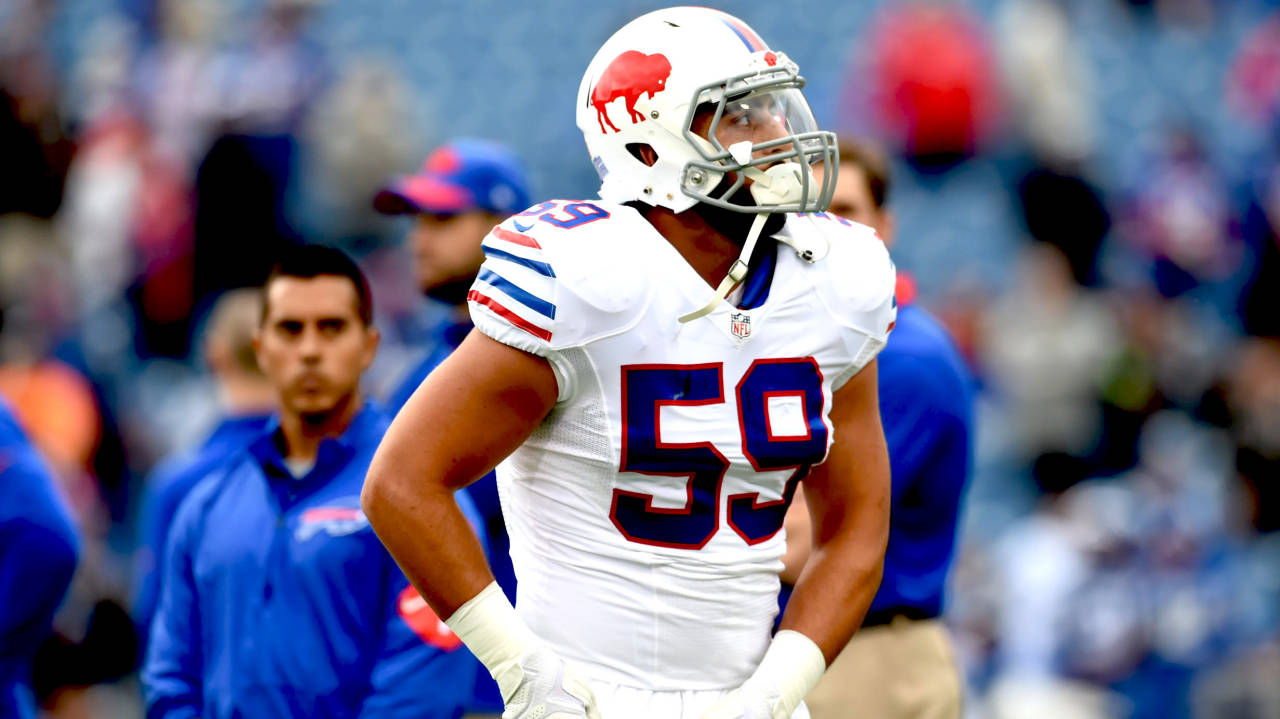
For professional football players, confidence and physical strength go hand-in-hand, and both are necessary for success on the field. For A.J. Tarpley, a former professional linebacker for the Buffalo Bills, those two characteristics formed the basis of his professional identity. "I lived by the Superman myth," he recalls. "I convinced myself I was indestructible."
But Tarpley's very first defensive play during a 2015 regular season game at Wembley Stadium in London rocked that confidence. A running back for the Jacksonville Jaguars struck the crown of Tarpley's helmet, resulting in a concussion—the fourth of his football career. "I remember my field of vision being closed in the whole time as if I was wearing horse blinders," he recalls. "But I tried to shake it off and stayed in the game."
Unfortunately, Tarpley's resolve faded as his body began to rebel. "Four plays and a goal-line stand later, I found myself in the locker room while the game was ongoing," he says. "I vividly remember sitting there and beginning to lose all sensation in half of my body."
The mind game of personal identity
Before that game, Tarpley had a somewhat nonchalant attitude toward head injuries; in fact, he had concealed a recent concussion suffered during training camp. "In the NFL," he explains, "the best ability is availability. I thought disclosing my injury might affect my eligibility to play." However, after the London game—a difficult 34-31 loss in the final minutes—Tarpley realized that there was no way of hiding his temporary paralysis and loss of peripheral vision. Especially from himself.
"Flights home from an away game after a loss are always solemn, to say the least," Tarpley explains. "But this flight being 6-plus hours back from London where my travel partners were a splitting migraine and my entire NFL future in the balance made it that much worse. I knew I was facing a reckoning."
So, at just 23, Tarpley walked away from his supportive coach Rex Ryan, a seven-figure contract, and his childhood dreams of being an NFL player. "It was the hardest decision I've ever made," he remembers. "Football was my identity. It gave me purpose, relationships, life experiences, and even my education at Stanford."
But his retirement was short lived. Since childhood, Tarpley had dedicated his life to being a football player, so it wasn't all that surprising that he was suiting up again three years later, this time with the Alliance of American Football (AAF) and the XFL. He played for two more years before finally retiring for good in 2020.
Once a team player, always a team player
Early in his football career, Tarpley learned that a locker room offered a complex spectrum of personalities, backgrounds, and life experiences. Beyond the smell of menthol rubs, the donning of shoulder pads, and the clatter of cleats marching toward to the field, the locker room served as a communal space where high achievers discussed football, families, and finances.
"In an NFL locker room you become close with people from different backgrounds, all who have different levels of experience with money," Tarpley says. "You'll meet people who come from nothing and suddenly earn millions of dollars."
Tarpley found that a pattern kept recurring in the locker room, as many of his teammates’ rapid ascent from minimal assets to extreme wealth often comes with an equally quick downfall. "You see some athletes go bankrupt or make a bad decision and it’s plastered all over news, right? The truth is you can't be great at everything, and it can be unfair to blame people for what they don't know about navigating complex and emotional financial issues."
On an NFL team, players rely on the special skills and knowledge of their teammates—and Tarpley found his knowledge and skills in demand. "I had a full circle moment when my former teammates labeled me the 'finance guy' and began calling me about reading credit reports, interpreting rookie contracts, and assessing personal advisor fees or investment proposals."
Given his informal career educating teammates, it isn't surprising that Tarpley was drawn to professional wealth management and J.P. Morgan after he retired. Today, he works with entrepreneurs, executives, and, naturally, athletes. Being a trusted financial advisor, Tarpley says, is similar to being a coach. "Everything feels familiar because both sports and wealth management involve psychology. Finance is more than spreadsheets. It's emotional, strategic, and requires someone's hard-earned knowledge to help navigate the more mental challenges."
Playing the long game
Tarpley's lifelong journey as an athlete to becoming a financial advisor has inspired him to give back to communities and kids who he thinks are being underserved. But he notes that this isn't entirely altruistic.
"As a young person, I was fortunate to to have mentors who helped me. So anytime I can give that same help and pay it back, pay it forward—it’s the least I can do," Tarpley explains. "If I didn’t have those mentors, I certainly wouldn’t have gone to Stanford, or the NFL. I wouldn’t be here."
Today, Tarpley is continuing to help his former teammates and current-student athletes while teaching financial literacy at Boys and Girls Clubs. To make the material relatable to schoolkids, he uses sports analogies, reframing complicated financial jargon as a "playbook" with its own grammar, rules and scorecards—not unlike football.
With his teaching, Tarpley finds himself completing the circle that began with his own coaches, progressed through his football career, and continues in his financial advising at J.P. Morgan. "When you're teaching, you learn about yourself and you learn about the kids," he says. "You help these young minds get better at having the conversations about money. So these opportunities, well, they kind of hit everything for me."