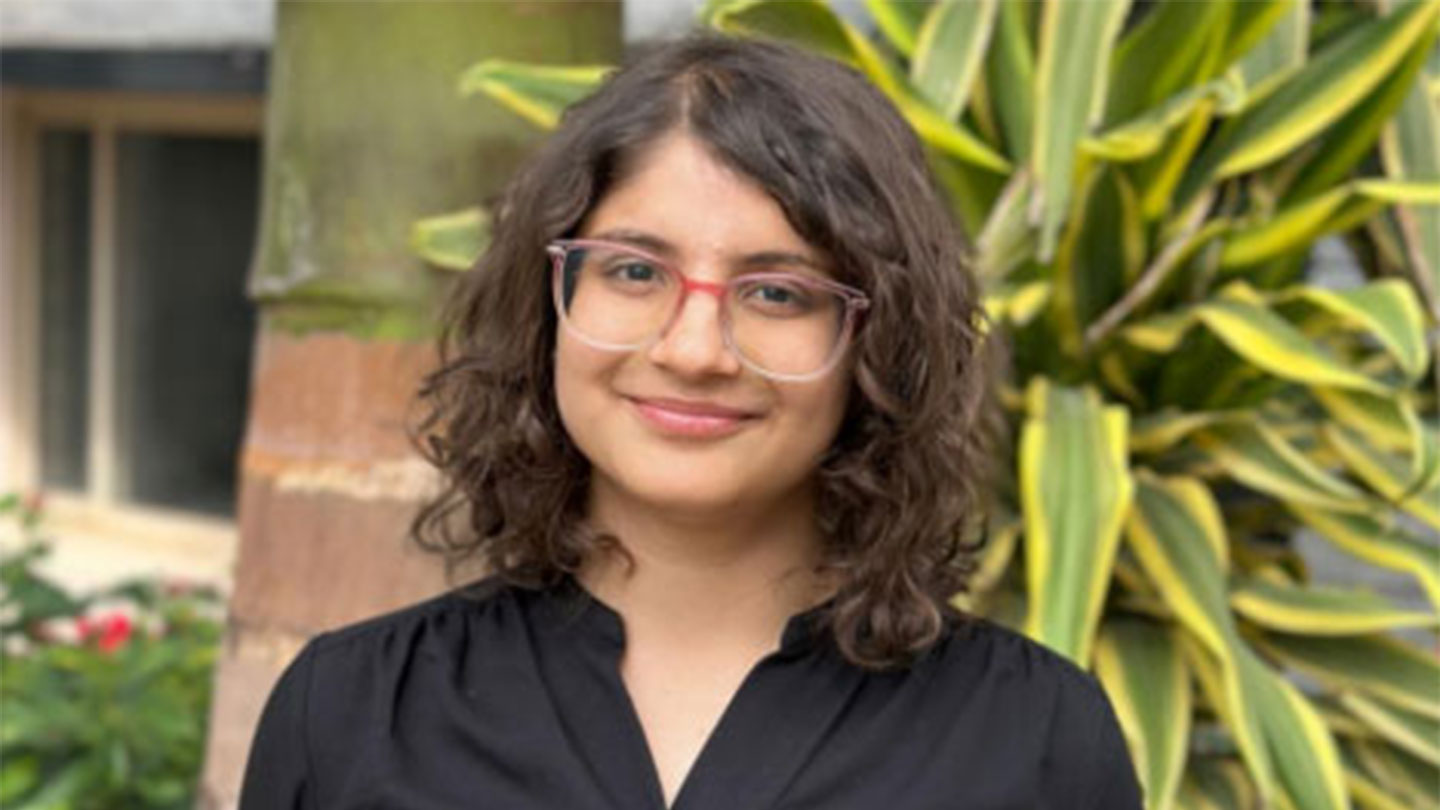
Meena did not think that she would jump into an engineering role right after college. She studied computer science and enjoyed building, but she was equally drawn to the people side of work and initially considered pursuing an MBA after her bachelor’s degree. She wanted a role that balanced technical depth with collaboration and judgment.
Today, she has found that balance as a backend engineer in Chase payments fraud risk. Working in Fraud Risk Orchestration, Meena’s team routes data through the fraud detection pipeline so payments can be evaluated before they move forward. If a payment is happening through Chase, systems like hers help decide whether it looks trustworthy.
Her first step on this path was participating in JPMC’s Code for Good hackathon. Her experience at the event mirrored the way she aspires to work: collaboratively, thoughtfully, and with real-world impact. The experience showed her that strong engineering is not just about technical output, but also communication, teamwork, and sound decision-making—values she continues to build as part of the Software Engineer Program. Meena not only contributes to her engineering team, but she also creates community amongst her fellow early career software engineers by volunteering her time to plan learning and networking events for the program.
What convinced you to choose the firm?
Code for Good. I came in thinking I wanted a career where I would not only be measured by how much I could code. I wanted the space to be technical, but also collaborative, where communication and judgment matter, and where the work has a reason behind it. Code for Good made the culture feel real instead of hypothetical
When you came to work at the firm, what was your first impression?
Collaborative, and way less judgmental than I feared. It was also more thoughtful than I expected. Things were not fast for the sake of fast. The vibe was: understand the problem, think twice, and build it right, especially when you are working on systems that have real consequences.
What is your favorite thing about interacting with your managers, co-workers or team?
The fun, and the calm confidence. Most people on my team were quite senior, and when I joined, I was the outlier. Even the second-youngest person had more than five years of experience on me. You would think that would feel intimidating, but it is actually what makes the environment so good. People do not panic, they do not posture, and they do not make you feel small for asking questions. The work is serious, but the energy is light. I learn a lot just by watching how they think.
What do you think would surprise people about your job at the firm?
People assume fraud work is dramatic, like you are chasing a villain in real time. In reality, it is more like being obsessed with details in a very specific way.
A lot of my day is asking questions that sound simple but are not. What signal do we trust? What happens when a dependency is slow? How do we protect customers without making the experience painful for people doing perfectly normal payments? It is less about hero moments and more about building decision flows that are careful, explainable, and resilient, because small choices matter when you are sitting in the middle of payments.
What is one challenge you faced at work that really helped you grow?
If I am honest, my biggest challenge early on was imposter syndrome. I was surrounded by people who had been doing this for years, and it took me a minute to stop treating every question like a test. What helped was that my team was genuinely welcoming. Over time, I learned that the fastest way to grow was to ask the question, get the context, and keep moving. That shift, from trying to appear confident to actually becoming confident through learning, changed everything.
If you could talk to your younger self about their job search, and especially about going to work at the firm, what advice would you give?
Be brave, and do not try to fit into one narrative of who you are. I used to think you had to pick a lane: the math person, the writer, the creative, the engineer. But people do not work like that. There are mathematical writers. There are people who love calligraphy and also love systems. Even someone like Steve Jobs is a reminder that taste, intuition, and humanity can sit right next to technology, and sometimes that mix is the whole point. You do not need to compress yourself into something simple to be taken seriously. The right place will let you be complex.