JPMorganChase client was told in advance that they would be featured in advertising.
Like any young adult, Odjahnae Mitchell, 23, wanted to find a place of her own, something affordable that could meet her needs as a person with a disability. She hoped to stay close to her family; she has lived in the San Francisco area all her life. But finding an apartment that met these criteria was incredibly challenging.
San Francisco today is one of the most expensive cities in the world to build in, and its complex regulatory environment can present challenges for new development. At the same time, the wealth gap has continued to widen, leaving behind families, forcing workers into long commutes, and putting vulnerable communities at risk. In 2023, 40% of San Francisco renters were considered cost burdened, and the median price of a Bay Area home, as of August 2025, was $959,000.
But even under the best of circumstances, people with disabilities encounter significant obstacles when they seek affordable housing. They’re often on a fixed income; they struggle to find a home designed to meet their specific needs; and they face both discrimination and a lack of options.
Since 2019, JPMorganChase has helped develop and finance over 25,000 affordable rental homes in the San Francisco Bay Area. We’re working with local organizations, civic leaders, and thoughtful developers to make living in San Francisco affordable and accessible.
The Kelsey Civic Center
Located in the heart of downtown, directly across the street from City Hall, The Kelsey Civic Center was codeveloped by Mercy Housing California and The Kelsey, a not-for-profit co-founded by Micaela Connery and her cousin, Kelsey Flynn O’Connor. Born with multiple significant disabilities, Kelsey insisted on living independently, in her own apartment, and that’s the experience The Kelsey Civic Center is designed to provide to others.
As it happens, JPMorganChase wasn’t the project’s original lender, but mobilized to deliver financing in record time, during a period of industry-wide uncertainty. Connery calls JPMorganChase “a save-the-day supporter.” “We just want to be there for our clients, if our clients need us,” says James Vossoughi, Executive Director, JPMorganChase Community Development Banking. The firm has provided $51 million in construction financing and $1.2 million in permanent financing to help bring The Kelsey Civic Center to life.
Fiona Ruddy, Senior Project Manager at Mercy Housing California, the project’s codeveloper, recalls discussions with JPMorganChase’s team even before a new lender was chosen. “They were trying to get us to the best financing path in a way that really had nothing to dowith their own interest, but was in the benefit of the project. That really demonstrated to us JPMorganChase’s commitment to the affordable-housing-development community.”
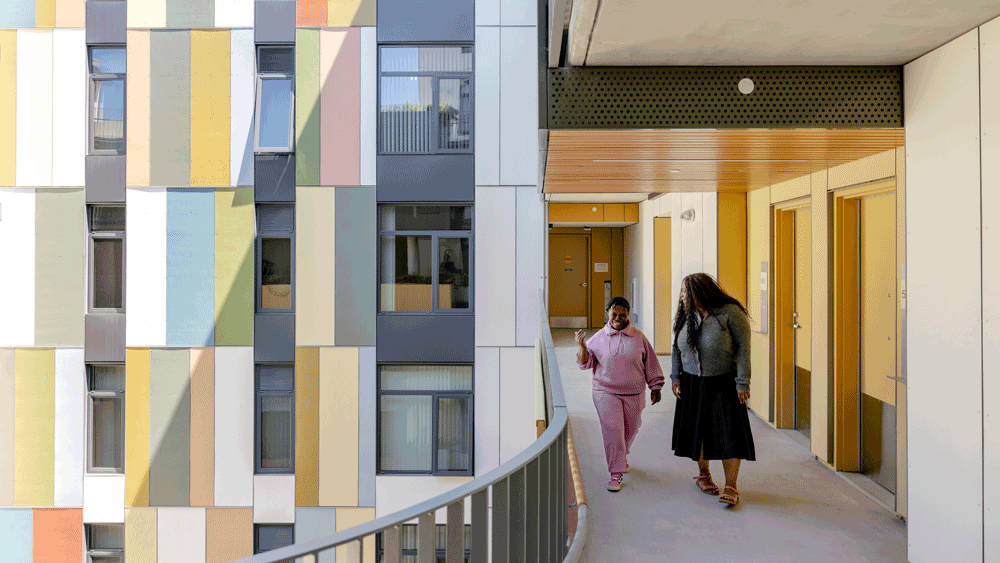
Some 7,000 people applied to live in The Kelsey Civic Center, including Odjahnae, via San Francisco’s affordable-housing lottery system. The mixed-income, mixed-ability building, which opened its doors in April 2025, comprises 112 homes for individuals and families making between 20% and 80% of Area Median Income, with 25% of them reserved for people with disabilities who use Home and Community Based Services.
“That's the great thing about it: Residents of The Kelsey live in a community that is just like any other market-rate community,” says Vossoughi. “They get the opportunity to have a home and live independently, just like everyone else.”
All of the building’s floors feature colored wayfinding for people with low literacy or low vision. The extra-wide hallways can accommodate two wheelchairs going in opposite directions. Tactile paving and acoustic ceilings create what the building’s architects call sensory “maps.” Two full- time staffers—known as the Inclusion Concierge team—support residents in orienting themselves in the neighborhood and city, connecting to external programs like healthcare and nutrition, and navigating the complex services system.
When Odjahnae was accepted into The Kelsey Civic Center, she felt both delight and anxiety. What if she struggled meeting new people? “But mostly, I was excited to finally have the freedom to do whatever I want in my own space,” she says.
She likes to hang out on the rooftop of The Kelsey Civic Center and listen to music. She has befriended some of her neighbors at the building’s regular bingo and movie nights, including a mother and daughter with whom she goes on walks. Recently, she and another neighbor went to the mall—the first time in her life Odjahnae had ever gone out independently. This year, she’ll celebrate the holidays for the first time living in her own place. “I’m excited to get my own Christmas tree,” she says.
1064 Mission
The goal of 1064 Mission—San Francisco’s largest supportive housing development for formerly homeless individuals—wasn’t simply to provide housing, says Ruddy. It was “to create a community where people can heal, grow, and really build brighter futures.”
Codeveloped by Mercy Housing California and Episcopal Community Services (which also provides services to residents), the building’s calming, inviting rooms and communal spaces are built to specific therapeutic standards, a feature known as trauma-informed design, for its residents: people who are exiting chronic homelessness. Forty percent of the 256 units are set aside for people aged 55 and up.
1064 Mission was assembled according to a model that potentially allows for significant savings of time and expense, depending on project and location: Its modular housing units were built offsite in their entirety, transported to San Francisco, then craned into place. 1064 Mission was made possible by $76 million in construction financing and $53 million in Low Income Housing Tax Credit equity from JPMorganChase.
The building’s residents have “experienced significant barriers to stable housing and need to be supported in the right way,” says Cécile Chalifour, Head of the West Region, Community Development Banking at JPMorganChase. To that end, medical and social-support services are housed on the ground floor: the Maria X Martinez Health Resource Center, including the Department of Public Health’s specialized street medicine program and dental services, and offices for the Homeless Outreach Team of the Department of Homelessness and Supportive Housing. The ground floor also includes a commercial kitchen and training center for Episcopal Community Services’ workforce-development and social-enterprise program. “You cannot say it enough times,” says Chalifour. “Permanent Supportive Housing works, but with services. You take out the services, and you have a building full of people whose needs are not being met.”
In JPMorganChase’s efforts to create and preserve affordable housing for vulnerable populations, 1064 Mission was “the right mission project,” says Chalifour. “And that’s very much the culture of the bank: Doing what's right, and doing it the right way.”
The testimonials are the sole opinions or experiences of those featured and not those of JPMorgan Chase Bank, N.A. or any of its affiliates. These opinions or experiences may not be representative of what all may achieve. JPMorgan Chase Bank, N.A. or any of its affiliates are not liable for decisions made or actions taken in reliance on any of the testimonial information provided.