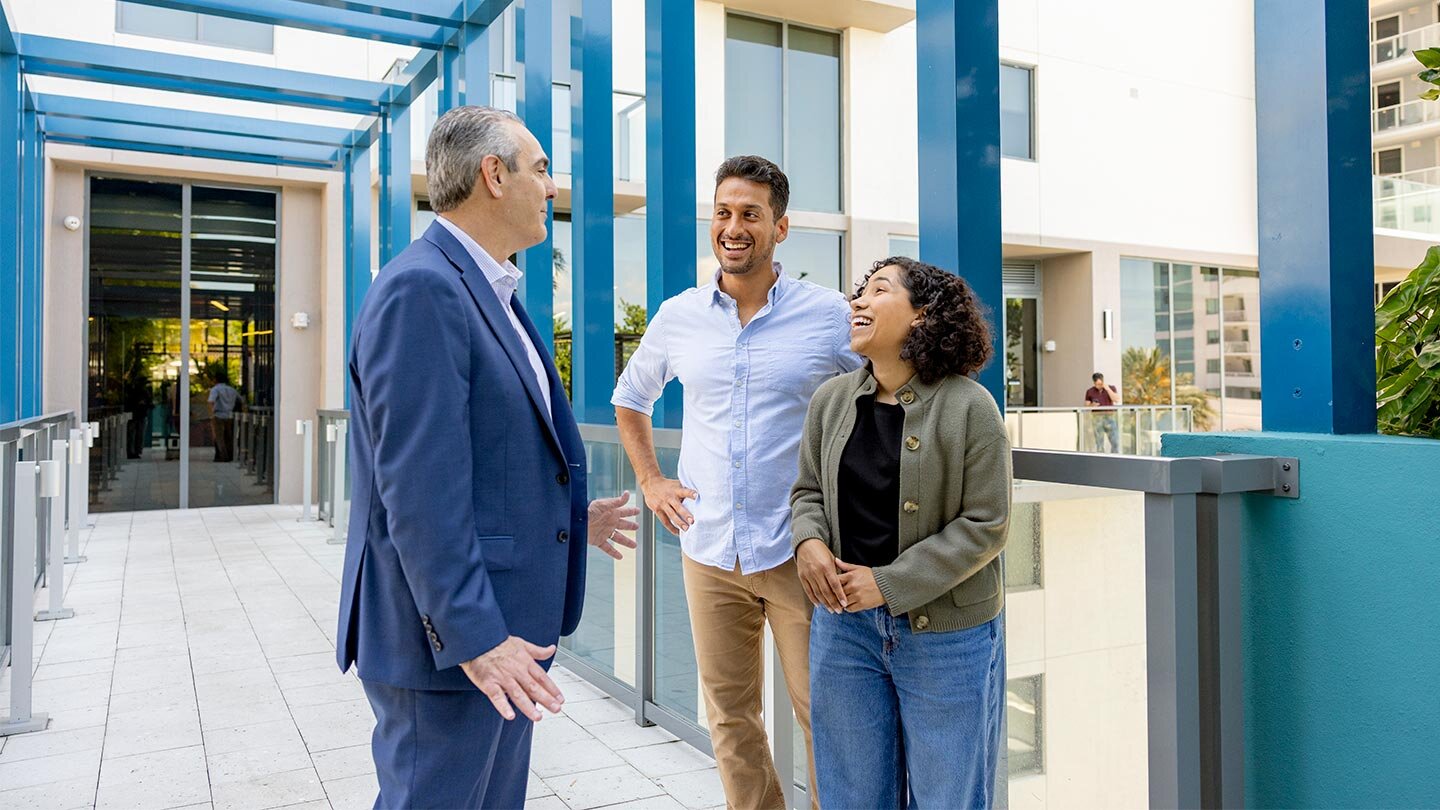
JPMorganChase client was told in advance that they would be featured in advertising.
In Miami, the fastest-growing startup hub in the United States, median income has jumped by 30% since 2019. The city’s gross domestic product increased by 56 percent—nearly $100 billion—between 2020 and 2024. That momentum is bringing opportunity, but it is also reshaping what it takes to afford to live in the city.
Miami now appears on lists of the country’s most unaffordable cities. Half of all Miami-Dade households are cost-burdened, meaning they spend more than 30% of their income on housing—the highest share seen in any large US metro.
Miami-Dade's housing gap reflects both heightened demand and a constrained supply of affordable homes. To close the gap, Miami-Dade needs 90,000 additional affordable units—a shortfall projected to grow to nearly 116,000 units by 2030.
JPMorganChase, which has served Miami for more than 45 years, is actively collaborating with affordable housing developers and government agencies to deliver creative and sustainable solutions to ease Miami’s housing crunch. Since 2021, we have helped build and preserve more than 4,300 affordable homes across Greater Miami.
Two initiatives we have helped support, the Magnus Brickell development project and the nonprofit Miami Homes for All, offers potential models for affordable-housing needs not just in Miami, but across the country.
A Mixed-Income Solution
From a distance, Magnus Brickell looks like classic Miami: a white high-rise with a tenth-floor pool deck and expansive windows overlooking Biscayne Bay and the downtown skyline. Behind its luxury finishes, though, is a transformative mixed-income development by Related Urban Development Group (Related Urban). Of the 29-story building’s 465 units, 93 are reserved for households earning 50 percent or less of the area’s Area Medium Income (AMI), and 70 units are reserved for those earning up to 140 percent of AMI.
Mixed-income developments make sense on both an economic and social level, says Alberto Milo, Jr., President of Related Urban: “The market-rate units generate revenue that helps maintain the quality of the building as a whole, while also fostering a sense of stability that encourages residents to make a long-term investment in their community. And because residents can transition between affordability levels – from subsidized rents to workforce rents to market rate – they can move up without ever having to leave the building or the neighborhood.”
To help bring that model to life, Community Development Banking provided $145 million to finance Magnus Brickell, the largest bond allocation JPMorganChase has awarded to any single development south of New York City.
Putting Together the Puzzle
Affordable housing is fundamentally linked to Miami’s social and economic health. “Housing is infrastructure for opportunity," says Tammy Haylock-Moore, Managing Director of Community Development Banking at JPMorganChase. "By helping finance this mixed-income development in Brickell, we’re supporting a community where working families and longtime residents can live closer to jobs, stay connected to family, and put down roots in a neighborhood that would otherwise be out of reach for many.”
Affordable housing helps to preserve the city’s legacy communities, allowing longtime residents to remain in the neighborhoods they’ve helped to build. JPMorgan has provided $4.45 million in support to Miami Homes for All, a nonprofit which helps advance the production and preservation of affordable, climate-resilient, small-scale multifamily housing in collaboration with Black, Latino, and Hispanic developers, property owners, and neighborhoods. We have mobilized our resources to help strengthen our communities, empower individuals and families, and help create thriving local economies.
On a larger scale, we worked closely with Related Urban on Magnus Brickell—not just to help create the project, which had a complex public-private funding structure, but also to maximize what it could offer. For instance, because of the site’s proximity to a light-rail station, Related Urban was able to rezone it and double the number of units.
In the region’s fastest-growing job sectors, which include healthcare, hospitality, and logistics, workers typically can afford no more than $1,000 per month for housing—practically impossible to find in a city where the average rent is $2,955. For senior citizens, the situation is even more acute. All of this made it crucial to maximize the number of units Magnus Brickell could provide.
The Right Lens
Though Magnus Brickell is a mixed-income project, every unit was built to the same standard, and with the same finishes. Every resident enjoys the same amenities—including a pool, sundeck, a state-of-the-art fitness center, an events venue, and an on-site podcast studio, among others. The result, says Milo, is a uniquely vibrant place in which different incomes and generations are commingled.
Potential funders may sometimes hesitate to invest in mixed-income developments like Magnus Brickell, Milo explains, believing that higher- and lower-income families will be reluctant to live together. But in JPMorganChase, he says, the project found a collaborator that understands the mixed-income model and is eager to embrace ambitious, forward-looking solutions to the city’s shortage of affordable housing. JPMorganChase, he says, “has been a great, great partner. They understand where Miami's growing.”
Opinions, findings or experiences of our customers and not those of JPMorgan Chase & Co. or any of its affiliates. These opinions, findings or experiences may not be representative of what all customers may achieve. JPMorgan Chase & Co. or any of its affiliates aren't liable for decisions made or actions taken in reliance on any of the testimonial information provided.