JPMorganChase client was told in advance that they would be featured in advertising.
For nearly thirty years, the corner of Vermont and Manchester in South Los Angeles reflected the effects of long-term underinvestment. The four-acre lot, once home to two bustling flea markets, was reduced to ashes during civil unrest in 1992. What remained was not just a vacant parcel, but a symbol—of disinvestment, broken promises, of a community left behind.
"This site was in the news every month," recalls Ken Lombard, president and CEO of BRIDGE Housing, the nonprofit that would eventually develop the site. "Vacant lots, a couple of older buildings, and a complicated ownership structure that delayed development for years."
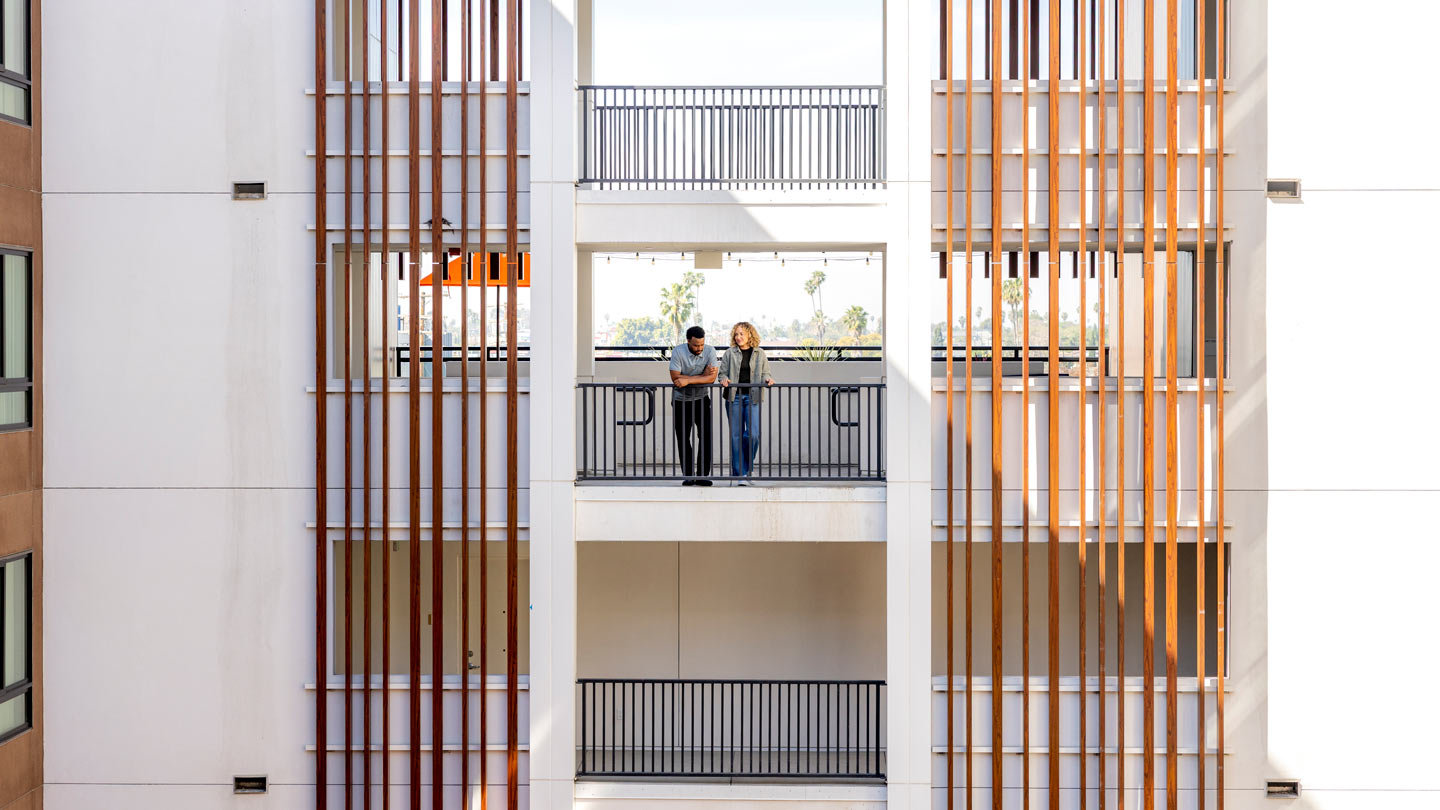
Today, that story has changed. Evermont (a name the community chose to honor "forever Vermont") is a 160,000-square-foot mixed-use development that brings 180 affordable homes—plus space for a major retailer, a Metro transit training facility, and an innovative boarding school—to a neighborhood where 78 percent of residents earn low to moderate incomes.
JPMorganChase, which played a key role in the project’s complex financing, believes in the power of developments like Evermont to lift up communities—as gathering places, places of employment, and locales for commerce. “Evermont is more than a housing development—it’s an anchor for a vibrant new vision of Vermont and Manchester and what this neighborhood can become,” said Cécile Chalifour, managing director of Community Development Banking at JPMorganChase, who coordinated a cross-division effort to support the project’s complex financing. “When we invest in projects like Evermont, we invest in long-term community strength—homes, services, jobs and renewed opportunities.”
Addressing a housing shortage
According to the California Housing Partnership, over 490,000 low-income renter households in Los Angeles County lack access to affordable homes, and 77 percent of extremely low-income households spend more than half their income on housing costs. The region is an estimated 270,000 units short of the affordable housing required to meet current demand.
Evermont represents a step toward addressing this severe affordable housing shortage. Its two residential buildings—Luminus, with 118 family apartments, and Vista, with 62 senior apartments—designate about two-thirds of their total residential units as permanent supportive housing, complete with wraparound health and social services, for people who have experienced chronic homelessness.
The development was co-created with the South LA-based Coalition for Responsible Community Development (CRCD) and a retail partner. "Thirty years after the LA civil unrest, we are excited to be a partner in the development team bringing affordable and permanent supportive housing and services," said Mark Wilson, CRCD's president and CEO.
The case for wraparound services
Research supports Evermont’s approach. Studies show that permanent supportive housing significantly increases long-term housing stability, particularly for individuals with high support needs, and that 86 percent of high-risk, chronically homeless individuals in permanent supportive housing remained stably housed for multiple years.
At Evermont, wraparound services include guidance on healthcare, shopping, transportation, and counseling—all provided by specialized service providers who work exclusively with formerly homeless populations.
"This is a tenant base that has a higher need than the average affordable housing tenant," Lombard explains. "We're there to provide them with guidance on how they make their life choices."
Beyond offering housing, Evermont can serve as an economic catalyst for the broader neighborhood. A retail partner at Evermont is creating more than 64,000 square feet of commercial space, which is expected to generate 155 full-time jobs. A local-hire program during construction provided approximately 120 job and training opportunities to community members.
"Your project is going to be more successful as a result of your local hire," Lombard says. "It really expands the community feeling of 'this is our project.'"
SEED LA, the county's first public charter boarding school, strengthens this feeling. Occupying an adjacent portion of the site, it gives preference to students who are homeless, housing insecure, or have incarcerated family members, and prepares them for careers in transportation infrastructure, STEM, and the humanities.
A financing structure years in the making
Making Evermont a reality required financial coordination on an unprecedented scale. The project leveraged funding from JPMorganChase, the Los Angeles County Development Authority, the California Department of Housing and Community Development, and a dozen other sources . The total development budget for the full project, including the SEED charter school and residential components, is estimated at $300 million.
"This project would not have happened were it not for that coordination," Lombard says. "Attorneys who had been in the affordable housing business for twenty-plus years said they had never seen a more complicated financing structure."
What carried Evermont's financing across the finish line, Lombard says, was the deep commitment of three JPMorganChase divisions: Community Development Real Estate, Tax-Oriented Investments, and New Markets Tax Credits.
A promise kept
For Lombard, who spent the majority of his career in market-rate real estate before joining BRIDGE Housing in 2021, Evermont represents a special kind of career milestone.
"I've had some projects that I would say are game-changers," he says. "The complexity of Evermont, the before-and-after picture—it's pretty close to the top of the list for me. You really feel like you've made a difference."
Looking ahead, he hopes Evermont stimulates further investment in the neighborhood. "This is a large enough project that it can really serve as an anchor for additional development," he says. "You show success with Evermont, and then others will follow."
The testimonials are the sole opinions or experiences of those featured and not those of JPMorgan Chase Bank, N.A. or any of its affiliates. These opinions or experiences may not be representative of what all may achieve. JPMorgan Chase Bank, N.A. or any of its affiliates are not liable for decisions made or actions taken in reliance on any of the testimonial information provided.