[trance music]
Woman 1:
I live with my father who's disabled. and I'm out of work.
Woman 2:
The kids eat every meal. But more times than not, at least one adult doesn't eat.
Rick Whitted:
Feeding five growing children has been tough. U.S. Hunger is a food organization, but it's really not about food at all. When we started hearing the stories, everything changed.
Ezekiel Brooks:
This year, we're feeding almost 19 million people. But feeding people indefinitely is not the solution. And so we decided we need to figure out why are they hungry in the first place.
Rick Whitted:
So we created a simple survey. The last question was: Why are you coming to us? Having a large set of data in the form of stories, we really had a seismic shift. We evolved from how do we get food into the community to why do we have to get food into the community? Our mission is to understand the data.
Ezekiel Brooks:
This is where JPMorganChase came in to help us.
Dhanashri Pitale:
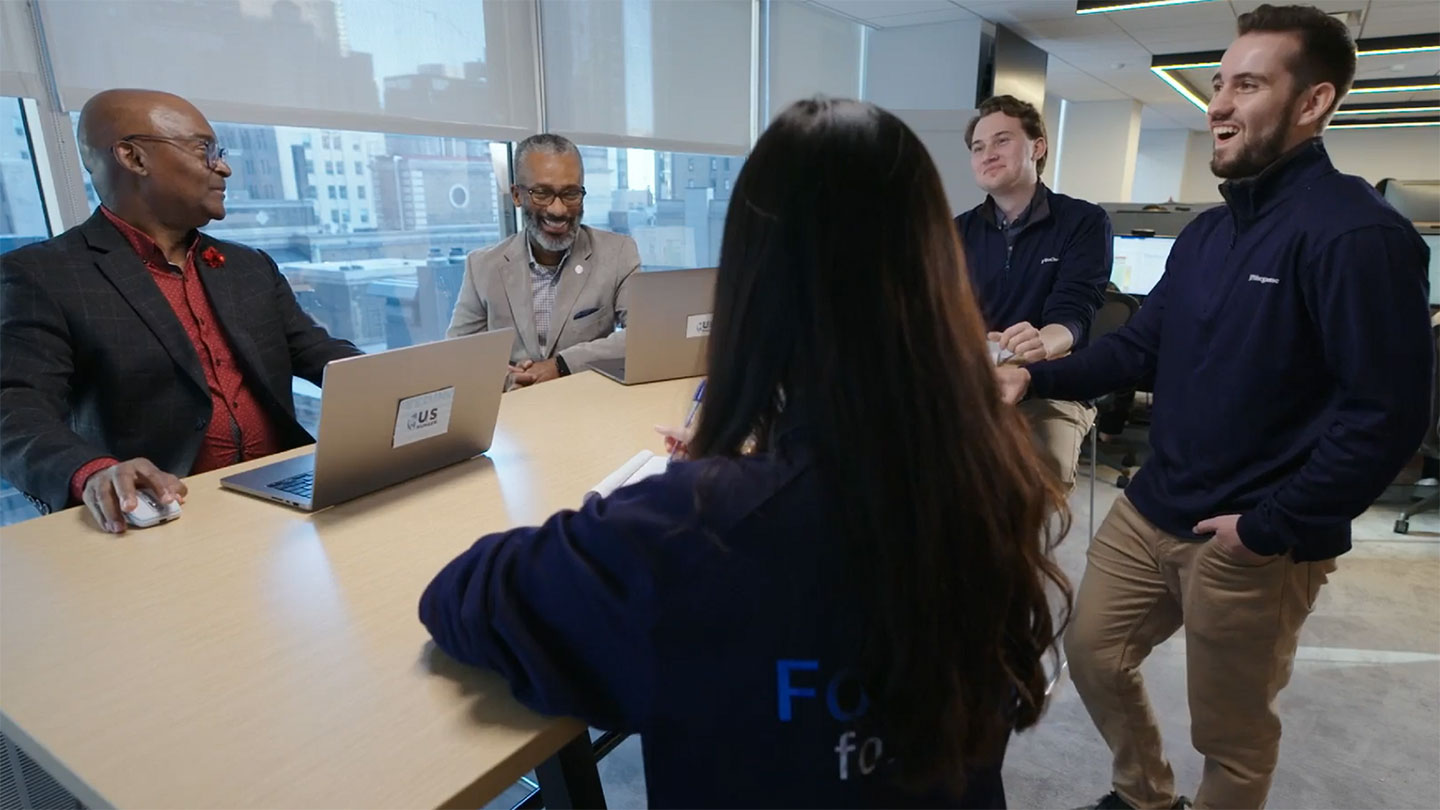
We have been working with U.S. Hunger for years through Tech for Social Good. The mission of Tech for Social Good is to drive impact in our communities through the skill set of our tech workforce. We have programs where we pair highly skilled JPMorganChase technologists with nonprofit organizations around the world to solve a problem that they are facing.
Ezekiel Brooks:
Awesome.
Dhanashri Pitale:
When U.S. Hunger came to us, they had a gold mine of data, and they really did not know where to start. We helped them take those next steps.
Ezekiel Brooks:
Year number one, we have hundreds of thousands of applications coming in. JPMorganChase helped us with machine learning to classify all of the applications from high, medium, to low urgency.
Rick Whitted:
The second project, we graduated to Al, beginning to turn the data we'd sorted into data analytics.
Ezekiel Brooks:
The data tells us that there's a whole universe of things beyond food that are actually the root of the problem.
Rick Whitted:
Things like housing and transportation and utilities, access to healthcare. Those are really the driving forces.
Steve Jansen:
During our Global Technology Senior Leaders Conference, I was part of a group of around 50 MDs that had an ideation workshop with U.S. Hunger, so I was very excited to sponsor one of the ideas coming out of that.
Rick Whitted:
We walked away with a real clear strategy on how to apply the technology in a most impactful way.
Steve Jansen:
In many cases, they can tailor a more targeted pitch to a potential corporate donor, create insights with potential partners or they can help inspire individual donors.
Rick Whitted:
The work with Tech for Social Good transformed our mission. So that next step for us, it's connecting to community-based organizations. Housing, education, employment, health care support, who actually do have the solution. There's no way we could have gotten this far without JPMorganChase.
Ezekiel Brooks:
With this data and technology, the use cases are virtually infinite.
Rick Whitted:
It's not data. It's a grandmother being a mom again. It's a veteran who just adopted two foster kids. It's a life. And the work we do enshrines the life through good technology. Will we end hunger? I don't know. But will we improve and lift the lived experience? Absolutely.
END