
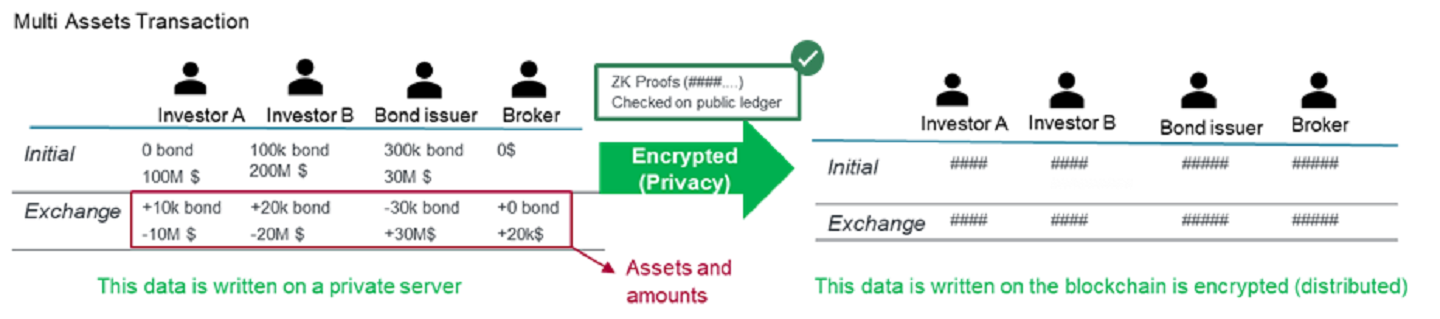
Figure. Example of a complex transaction with several parties and sensitive information. Left - is transparent, Right – is encrypted but verified with ZKPs.

Creating thriving communities together
See how our clients and partners—from small business owners to workforce training leaders—work with JPMorganChase to drive meaningful impact and economic growth where they live and work.
Learn moreLatest news

Veteran’s Unconventional Path to Landing her Dream Job in Tech
U.S. Army Veteran Ashley Wigfall transitioned to a civilian role and charted her path to technologist through mentorship and skills training at the JPMorgan Chase tech hub in Plano, Texas.
Learn more
Blog
Quantum-Resistant Distributed Ledger: A Path to Privacy in the Quantum Era
By Global Technology Applied Research
April 23, 2026
The typical public blockchain excels at transparency and removing intermediation. Financial institutions, however, have additional requirements for privacy, auditability, throughput and support for complex transactions. They're also preparing now to ensure resilience against future quantum threats. As a potential solution to these emerging needs, our research team designed a distributed ledger protocol that unifies privacy, auditability and quantum security in a single architecture.
While fully public blockchains expose data to the network posing potential risks for transactions given the sensitivity and volume of activity, zero-knowledge proofs (ZKPs) offer a way to maintain confidentiality without sacrificing verifiability. Encryption alone obscures details but can undermine scalable verification; ZKPs instead prove properties of encrypted transactions without revealing the underlying data, enabling end-to-end auditability across public blockchains or distributed systems.
What do we need to check in ZKPs?
The first check is that the transaction is balanced, that is, the conservation of assets. We also need to check that the parties who send assets have enough assets to start with, proof that the transaction is signed by the owner of the asset and some extra properties to make sure that cryptography cannot be falsely generated or forged.
Figure. Example of a complex transaction with several parties and sensitive information. Left - is transparent, Right – is encrypted but verified with ZKPs.
While ZKPs have potential use in this context, they also introduce significant computational overhead, and implementation complexity relative to transparent ledgers. These challenges are especially pronounced in financial workflows involving multiple assets and participants. But here’s the honest biggest challenge: the most ‘elegant’ and widely used ZKP frameworks tend to lack quantum resistance, while quantum‑resistant options are much larger and more computationally expensive. As a result, today’s blockchains, which are optimized for high throughput and fast validation, are not geared to introduce post-quantum ZKP, with large compute costs and data in a single transaction.
Our team developed a Quantum Private and Auditable Ledger - QPADL - Technical paper. It leverages quantum-resistant cryptography primitives to develop a new scheme for private transaction data. For the first time, we show a ‘compact’ transaction protocol, capable of processing hundreds of encrypted assets together in a single, encrypted and fully auditable transaction, enabling potential efficient operations in high-volume financial use cases. It may also have potential to be used for multi participants and batch transactions.
Showcase of compact protocol | Q-PADL (fully auditable) | Ring-CT Schemes (partially auditable) |
Transaction Speed per Asset (single core) | ~4ms | ~100ms |
Effective Size per Asset | ~6KB | ~50KB |
Table. Performance and transaction size comparison between Q-PADL and Ring-CT Schemes. Tests are locally without network overhead. On blockchain, performance expected, depends on network communications and blockchain specifications.
The extra benefit of privacy with quantum resistance is that it can be used on existing blockchain infrastructures that are not themselves quantum resistant. We highlight that it provides a ‘safe box’ within a quantum attackable environment. This ensures long-term confidentiality and compliance now. It can provide a way to maximize the usage of current established existing ledger technology during the transition to all quantum ready blockchains, which could take years.
This work lays the groundwork for future adoption of privacy and security in public blockchains. At JPMorganChase, we’re proactively securing our future with post-quantum technologies by upgrading and assessing our cryptographic systems and enabling crypto agility so we can adopt quantum-safe standards.
The protocol and its implementation details are available at this point in the full Technical paper.