JPMorganChase client was told in advance that they would be featured in advertising.
Mike Burdick didn't grow up dreaming about tractors. The son of a packing-house owner, he arrived at Iowa State University with business on his mind and scant understanding of production agriculture. Today, as VP of Sales and Marketing at Sabanto, an Ames, Iowa-based company that makes self-driving tractors, he finds himself at the intersection of Iowa's past and future—addressing one of agriculture's most critical challenges with innovation that's transforming how farming gets done.
Iowa is the nation's top producer of corn, pigs, eggs, ethanol, and biodiesel—and agriculture underpins a significant share of its economy. According to a 2024 study by the Coalition to Support Iowa's Farmers, the industry contributes $159.5 billion to Iowa's economy, accounting for roughly one-fifth of the state's total economic output—up 31% from five years ago—and supporting jobs for approximately 19% of Iowans. But that foundation faces real pressure, and companies like Sabanto, with support from JPMorganChase, are part of the solution.
An evolving workforce
The average age of American farmers is rising. As that demographic shift accelerates, the number of farms is diminishing, providing fewer opportunities for young people to enter the agriculture industry—a "reverse brain drain,” as Burdick puts it.
“Skilled farm labor is getting incredibly difficult to find," he explains. "This is not a new problem—this is a forty-, fifty-year consistent issue that's gotten more dire as time has gone on.”
The evolution extends beyond hiring. Many farm operations are extremely time-sensitive, with narrow windows for completion of seasonal work. Add in enormous capital costs—large tractors represent massive investments—and the pressure on farmers becomes immense.
Against this backdrop, farmers are looking for solutions that let them do more with the resources they have: streamlining tasks, right-sizing equipment, improving planning, and protecting margins—while maintaining the output their operations depend on.
Rethinking the economics of farming
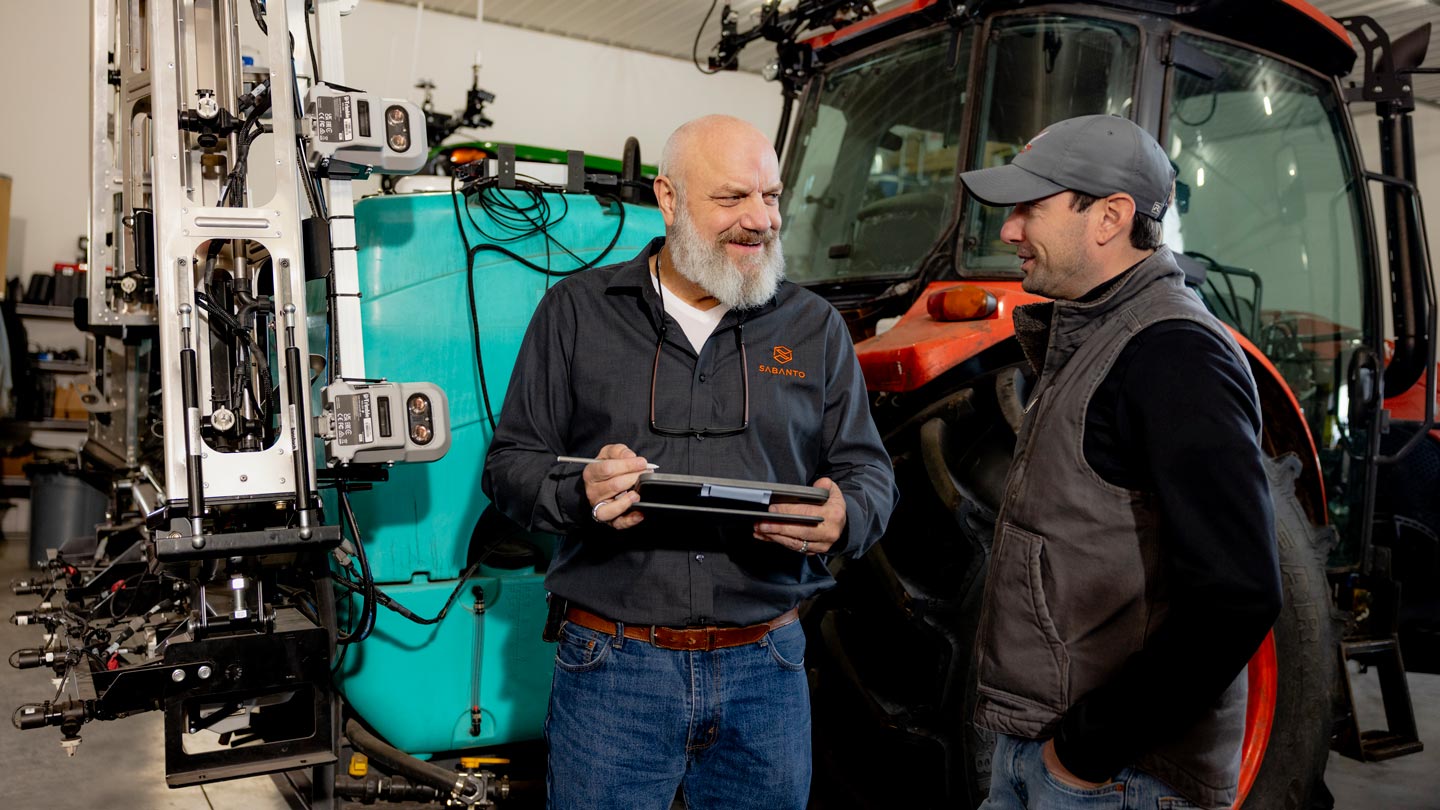
Sabanto's answer to this problem is transforming production agriculture. Rather than building bigger, more expensive tractors, the company retrofits existing ones. Simply put, says Sabanto’s CEO, Craig Rupp, “What we do is turn that manually operated tractor into an autonomous tractor.”
The model, which Sabanto’s engineers developed in close consultation with farmers, turns conventional agricultural economics on its head. In the past, one operator managed one massive, expensive machine. But Sabanto's technology enables a single person to oversee multiple smaller tractors working simultaneously. Three to five 100-horsepower tractors can outwork a 500-horsepower behemoth—at 50% to 70% of the cost.
For small farmers, the technology can provide unprecedented flexibility, even enabling some of Burdick’s customers to keep their businesses going. "I've had multiple growers this season say, 'Based on the economics of farming today, being able to work in this fashion will enable us to keep farming for years to come,'" he says.
Building on Iowa's foundation
Sabanto's growth story is distinctly Iowan. The company draws on Iowa State University's agricultural-research legacy and the state's deep history of farming.
Sabanto's sales process reflects Iowa's agricultural culture, one where farmers are “very do-it-yourself, very entrepreneurial, very self-reliant,” Burdick says. The company routinely arrives at farms, unloads a retrofitted tractor, gets it operating within an hour, and then leaves it with the farmer for a week or two.
"That is the way to win the hearts and minds of growers,” Burdick explains. “Not to supplant them, but help them work smarter, not harder."
This commitment to solving real-world problems has enabled Sabanto, which began as a startup, to grow into a company serving operations of up to 20,000 acres, from small family farms to large corporate agricultural enterprises spanning multiple states.
A financial partner for Iowa's evolution
Innovations like Sabanto’s will help the state’s agricultural sector continue to grow—and make it an attractive market for financial institutions looking to support America's farming future.
JPMorganChase's commitment to Iowa goes beyond banking customers like Sabanto. As the firm expands to more than 30 branches across the state by 2030, it's also deploying philanthropic capital to strengthen the agricultural communities that anchor Iowa's economy. That includes a $250,000 commitment to the American Flood Coalition to support the organization's work helping family-owned farms to improve soil health, promote crop diversity, and reduce flood risk downstream. In serving its communities, JPMorganChase brings the full force of the firm, pairing financial services with targeted investment to help businesses and local economies grow together.
JPMorganChase works with nearly 25,000 Iowa-based businesses, in industries from agribusiness to manufacturing to education to healthcare. It’s the kind of support that can evolve alongside a growing company: For Sabanto, what began as a small-business banking relationship has grown in step with the company’s expansion. “JPMorganChase has helped us scale our business,” says Rupp.
JPMorganChase understands that local businesses—especially in agriculture-adjacent fields—face unique challenges. The bank provides the agility to move quickly, the expertise to navigate complex decisions, and the collaborative mentality that recognizes entrepreneurial realities.
Staying power in the heartland
As Iowa continues evolving, balancing its agricultural heritage with technological innovation, companies like Sabanto demonstrate what's possible when deep industry knowledge meets entrepreneurial ambition. And when those companies find financial collaborators who understand local business realities, they can make long-term commitments to communities, strengthening the entire local economy.
For Burdick and the farmers he works with, the goal was never to reinvent agriculture—it was to make it more viable. Autonomous technology is just the latest tool in a long line of innovations that have helped Iowa farmers work smarter, adapt to new pressures, and keep doing what they've always done.
The testimonials are the sole opinions or experiences of those featured and not those of JPMorganChase Bank, N.A. or any of its affiliates. These opinions or experiences may not be representative of what all may achieve. JPMorganChase Bank, N.A. or any of its affiliates are not liable for decisions made or actions taken in reliance on any of the testimonial information provided. Deposit, credit card and lending products provided by JPMorganChase Bank, N.A. Member FDIC.